Sultai Arisen precon upgrade guide
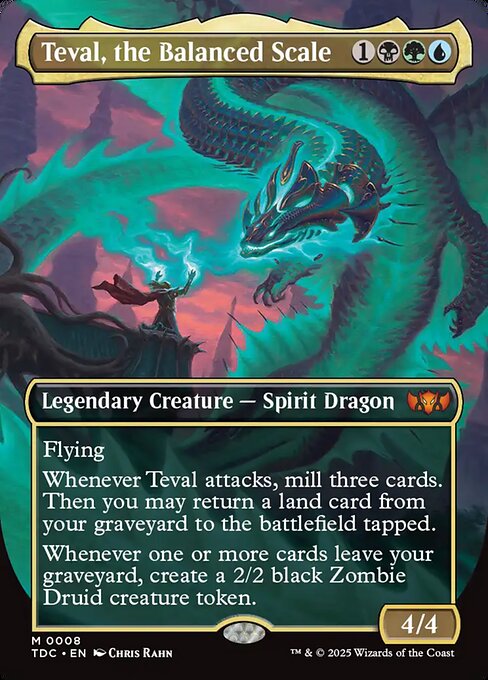
Teval, the Balanced Scale makes one Zombie whenever cards leave your graveyard — per event, not per card. The box never noticed: its delve spells trade up to seven cards for a single token, while a land replayed from the graveyard pays full price every turn. Thirteen swaps, about $54, rebuild Sultai Arisen around the cheap exits.
The figures below come from resolving the shipped Tarkir: Dragonstorm decklist one card at a time — tap conditions on every land, pip odds, curve, bracket floor — and the after-swap figures come from putting the thirteen swaps into that same list and resolving it again.
 16
16 19
19 18
18Upgraded list: 100 cards, 36 lands (15 basic), 39 creatures, average mana value 3.46. Mana sources: 16 blue, 19 black, 18 green. No Game Changers and no mass land denial, so the deck sets no bracket floor. How brackets work →
What are the best Sultai Arisen upgrades?
Ranked by what each card does for this list. The slots come from the cuts.
- World Shaper ($9.84) — a second copy of Teval's attack trigger, and when it dies every land card in your graveyard comes back. The box already runs the sacrifice outlets to kill it on demand.
- Splendid Reclamation ($0.35) — the spell this engine was missing. With 36 land cards in the deck, Teval's own mill banks lands every combat; this returns all of them for four mana.
- The Gitrog Monster ($0.50) — an extra land drop plus a card every time a land card hits your graveyard from anywhere, which in this deck is constantly. Fifty cents.
- Syr Konrad, the Grim ($1.19) — reads the same events as Teval and turns them into damage: every creature milled, every creature that leaves your graveyard, every creature that dies anywhere.
- Aftermath Analyst ($0.63) — mills three on entry and sacrifices into a second Splendid Reclamation for four mana.
- Ramunap Excavator ($5.76) — a land played from the graveyard every turn is a Zombie every turn, and it turns the deck's self-sacrificing lands into engines.
- Altar of Dementia ($17.37) — the priciest add and the best sacrifice outlet printed for this plan: free, instant, and the mana stays in your pool for Gravecrawler.
- Toxic Deluge ($4.59) — a sweeper is at its best in the deck that rebuilds from the graveyard while everyone else rebuilds from hand.
- Assassin's Trophy ($0.90) — two-mana removal that hits any permanent, in a box that shipped four spot-removal spells.
Underground River ($1.89), Waterlogged Grove ($1.53), Nurturing Peatland ($6.76) and Blooming Marsh ($3.06) take over from five lands that always enter tapped. Every pick gets its argument below.
A Zombie per event, not per card
Read Teval's last line again: “whenever one or more cards leave your graveyard, create a 2/2 black Zombie Druid creature token.” Seven cards delved under Treasure Cruise and one card escaping under Woe Strider pay out exactly the same token. The box ships four payoffs that read those exits — Teval, Teval's Judgment, Kishla Skimmer and Essence Anchor — and then ships three delve cards that spend the graveyard seven cards at a time.
So the deck's real currency is events: small, repeatable exits, ideally free ones. The box has more of these than it seems to know. Gravecrawler recasts from the graveyard for one mana any time you control a Zombie, and Teval hands you a Zombie for doing it. Reassembling Skeleton and Drownyard Temple come back for two and three. Phyrexian Reclamation, Timeless Witness, Nyx Weaver and Shigeki, Jukai Visionary all pull cards out one transaction at a time. Best of all is the commander's own second line: every Teval attack mills three and returns a land, which is a Zombie, a Judgment mode and a Kishla Skimmer card — every combat, for zero mana.
The swap list is this paragraph applied thirteen times: the bulk spenders go out, the one-card-at-a-time machines come in.
The mill is really land ramp
Thirty-six of the upgraded deck's hundred cards are lands, so Teval's mill-three banks roughly a land per attack — and this deck treats a land in the graveyard as a land in hand. The box already reads that way: Life from the Loam and Conduit of Worlds retrieve them, Floral Evoker and Shigeki, Jukai Visionary trade cards for them, Crawling Sensation pays an Insect the first time one hits the bin each turn, and Multani counts them all from both zones.
What the box never includes is the spell that cashes the whole account at once. The upgrade adds three: Splendid Reclamation, World Shaper and Aftermath Analyst all read “return all land cards from your graveyard to the battlefield.” Five lands returned is five landfall triggers — Hedron Crab mills fifteen, Avenger of Zendikar's Plants grow five times, and Ob Nixilis deals 15 life in threes while gaining fifteen +1/+1 counters. The box shipped those landfall payoffs with almost nothing to trigger them; the adds are the trigger.
Nine tapped lands, twelve double-black spells
The stock mana base makes two promises it can't keep at once. Nine of its 37 lands always enter tapped, which taxes a commander who wants to attack on turn four. And twelve spells want {B}{B} — Living Death, Junji, the Midnight Sky, Necromantic Selection and nine more — against 21 black sources, which resolves a turn-three double black at 61% on the play. The worst offender asks for both at the top of the curve: Afterlife from the Loam costs eight with triple black.
Five taplands leave — Memorial to Folly, Haunted Mire, Contaminated Aquifer, Golgari Rot Farm and Temple of Malady — and four untapped duals arrive. That is an honest trade, not a free one: black slips from 21 sources to 19 (a turn-two black spell goes from 86% to 83% on the play), bought back partly by cutting the deck's two hardest black casts. What it buys is real: untapped lands go from 24 to 27, always-tapped from nine to four, and blue — the deck's thinnest colour — ticks up from 15 sources to 16. The four taplands that stay all earn the turn they cost, argued below.
The curve moves the same direction. The box runs eleven cards at mana value six or higher and averages 3.73; after the swaps it's seven cards and 3.46, with the two-drop count up from fifteen to eighteen.
What I'd cut
Treasure Cruise and Tasigur, the Golden Fang are the exchange-rate cuts. Delve here isn't free mana; it's mana bought with the deck's resource. Up to seven cards leave in one event — one Zombie — and every creature among them stops being a Living Death or Victimize target. Tasigur adds insult: six mana for a 4/5 whose activation lets an opponent pick what you get back.
Afterlife from the Loam wants eight mana including {B}{B}{B} from 19 black sources, and delving to cheat the total exiles the same graveyard it's reanimating from. The deck keeps Living Death, which does the mass-reanimation job for five.
Casualties of War costs {B}{B}{G}{G} in a base that resolves a turn-four double green 58% of the time and a turn-three double black 61% — both contested pips stacked on one six-mana sorcery.
Consuming Aberration reads the wrong graveyards. It grows off what your opponents have milled and mills them further — and nothing else in the deck cares about their bins. Five mana, no protection, no evasion beyond size.
Amphin Mutineer is four-mana removal that donates a 4/3 replacement. Assassin's Trophy answers strictly more for half the mana and donates at most a basic land.
Forbidden Alchemy digs four cards deep, which Grisly Salvage and Grapple with the Past already do at instant speed for less, and its flashback costs seven.
Essence Anchor is the fourth and weakest leave-the-graveyard payoff: one Zombie a turn, only on your turn, only if something already left — the token Teval usually made anyway. Its slot goes to Syr Konrad, the Grim, who reads the same events as damage instead of a duplicate.
The five lands — Memorial to Folly, Haunted Mire, Contaminated Aquifer, Golgari Rot Farm and Temple of Malady — buy their colours with lost turns. The Rot Farm is the worst of them here: it bounces a land you already paid for, in a deck whose commander returns lands tapped and wants every untapped source it can find.
What I'd add
World Shaper ($9.84) attacks for the same mill-three as the commander, then dies into a full Splendid Reclamation. The box supplies the death on demand: Jarad, Disciple of Bolas, Woe Strider, Lord of the Forsaken and Victimize all sacrifice, and Meren of Clan Nel Toth returns it to do it again.
Splendid Reclamation ($0.35) and Aftermath Analyst ($0.63) are the other two copies of the effect. Redundancy is the point: the deck banks lands every single turn, so the game where none of the three shows up is the one you're trying to delete.
The Gitrog Monster ($0.50) draws a card whenever land cards reach your graveyard from anywhere — Teval's attack mill, Satyr Wayfinder's spill, Grisly Salvage's rejects, its own upkeep. Add the extra land drop, and the land Teval just returned is often followed by another from hand.
Syr Konrad, the Grim ($1.19) is the payoff the token plan was missing: with 39 creatures in the upgraded list, every mill that flips a creature hits each opponent, every reanimation spell pings on the way out of the graveyard, and a board wipe becomes a burn spell. He wins games this deck previously stalled in.
Ramunap Excavator ($5.76) plays lands out of the graveyard, and each one is a leave event — a Zombie, a Judgment mode, a Kishla Skimmer card, per turn, forever. It also converts Terramorphic Expanse, Myriad Landscape, Foreboding Landscape and Cephalid Coliseum from one-shot lands into engines.
Altar of Dementia ($17.37) is the list's one real splurge, and it earns it. A free sacrifice outlet converts any creature into fuel at instant speed, and with a Teval token on the table it assembles the deck's best loop: one black mana recasts Gravecrawler from the graveyard — a Zombie and a ping on the way out — then the Altar eats it to mill two more. Every iteration feeds every payoff the deck runs.
Toxic Deluge ($4.59) and Assassin's Trophy ($0.90) fill the interaction gap: the box shipped four spot-removal spells and one sweeper. Deluge is the asymmetric pick for a deck whose creatures come back — and at $4.59 against Damnation's $20.60, the budget version is also the better buy. Trophy replaces the removal Amphin Mutineer was pretending to be.
The lands: Underground River and Blooming Marsh shore up black, Waterlogged Grove and Nurturing Peatland cover the other pairs and cash in for a card when the game goes long — and a canopy land sacrificed for its card lands in the graveyard, where Teval returns it on the next attack.
Two cards were priced out rather than argued out, and one was crowded out. Ancient Greenwarden ($12.44) doubles every landfall trigger and plays lands from the graveyard, but it's a six-drop in a list that just cut its top end from eleven cards to seven — it's the first purchase beyond this page. Mesmeric Orb ($17.93) is eighteen dollars of mill in a deck that already mills on attack, entry, upkeep and sacrifice. Titania, Protector of Argoth ($0.32) is the odd one: thirty-two cents, genuinely strong, and skipped only because the thirteen slots went to cards that feed the Zombie engine directly — pair her with Fabled Passage ($1.11) as the first move past this list.
The cards that look like cuts and aren't
Will of the Sultai reads like a one-creature pump spell, and that's the mode you'll almost never pick. With your commander out you choose both modes, and the other one is “mill three, then return all land cards from your graveyard to the battlefield” — this deck's signature effect, in the box all along, hiding under a trample rider.
Necropolis Fiend delves like the cuts do, but its activated ability is the good version of the exchange: exile a few cards, at will, every turn — each activation a Zombie and a shrink effect on an attacker. The casting cost is the bribe; the ability is the card.
Living Death is a five-mana haymaker with no board presence of its own, which is exactly the profile the curve section cuts — but it's the payoff the whole engine deposits into. A dozen creature cards in the graveyard is an ordinary mid-game here, and it trades your 2/2 tokens for all of them at once.
Lord of Extinction has no evasion, no protection, and no text beyond its size — and it isn't a combat card. It's the deck's biggest number standing next to Jarad, whose sacrifice ability drains every opponent for its power. Four graveyards deep into a game, that's lethal at the table, not at one player.
Ob Nixilis, the Fallen and Avenger of Zendikar look like overcosted bodies until the mass land returns arrive. Five lands off a Splendid Reclamation is 15 life in threes from Ob Nixilis and five rounds of growth for the Avenger's Plants. The adds exist partly to make these two shipped cards good.
The four taplands that stay each pay rent. Crypt of Agadeem taps for a black mana per black creature card in your graveyard — a payoff, not a cost, in a deck that mills a third of itself. Fetid Pools cycles into the graveyard where Teval returns it: two mana for a card now and the land back later. Myriad Landscape sacrifices for two basics, then comes back from the bin to do it again. Opulent Palace is one of only three lands in the list that can produce all three of the deck's colours.
Tear Asunder gets dinged as conditional removal, and unkicked it is. Kicked for {1}{B} it exiles any nonland permanent — in a removal suite this thin, the flexible copy stays.
The list after thirteen swaps, measured
Thirty-six lands: 27 untapped, five conditional, four always tapped — the stock box ran 24/4/9. Average mana value 3.46, down from 3.73, with the six-plus shelf trimmed from eleven cards to seven. Black at 19 sources resolves a turn-two black spell at 83% on the play, a knowing three-point concession from stock's 86% in exchange for the speed; blue rises to 16 sources and 77%. Thirty-nine creatures, ten of them legendary. No Game Changers on either side of the swaps, so the bracket floor doesn't move. The upgraded hundred prices at $152.15 against the box's $102.19 — the thirteen adds run about $54 at August 2026 market prices.
The upgraded decklist
The full hundred with the thirteen swaps in. Hover any name to see the card and its current price.
“Load into the deck builder” opens this list in your account, pinned to the printings the box shipped, ready to edit or save. “Copy decklist” gives you plain text for Moxfield, Archidekt or Arena — no account needed.
Commander 1
- Teval, the Balanced Scale

Creatures 38
- Aftermath Analyst
- Avenger of Zendikar
- Colossal Grave-Reaver
- Dauthi Voidwalker
- Disciple of Bolas
- Diviner of Mist
- Floral Evoker
- Gravecrawler
- Hedron Crab
- Jarad, Golgari Lich Lord
- Junji, the Midnight Sky
- Kishla Skimmer
- Kotis, Sibsig Champion
- Lord of Extinction
- Lord of the Forsaken
- Meren of Clan Nel Toth
- Millikin
- Multani, Yavimaya's Avatar
- Necropolis Fiend
- Noxious Gearhulk
- Nyx Weaver
- Ob Nixilis, the Fallen
- Ramunap Excavator
- Reassembling Skeleton
- River Kelpie
- Sakura-Tribe Elder
- Satyr Wayfinder
- Shigeki, Jukai Visionary
- Skull Prophet
- Springbloom Druid
- Steward of the Harvest
- Stitcher's Supplier
- Syr Konrad, the Grim
- The Gitrog Monster
- Timeless Witness
- Woe Strider
- Wonder
- World Shaper






Instants 7
- Assassin's Trophy
- Grapple with the Past
- Grisly Salvage
- Harrow
- Lethal Scheme
- Putrefy
- Tear Asunder
Sorceries 11
- Cultivate
- Farseek
- Life from the Loam
- Living Death
- Necromantic Selection
- Rampant Growth
- Splendid Reclamation
- Toxic Deluge
- Victimize
- Welcome the Dead
- Will of the Sultai
Artifacts 4
- Altar of Dementia
- Arcane Signet
- Conduit of Worlds
- Sol Ring
Enchantments 3
- Crawling Sensation
- Phyrexian Reclamation
- Teval's Judgment
Lands 36
- Blooming Marsh
- Cephalid Coliseum
- Command Beacon
- Command Tower
- Crypt of Agadeem
- Darkwater Catacombs
- Dreamroot Cascade
- Drownyard Temple
- Exotic Orchard
- Fetid Pools
- Foreboding Landscape
- 6× Forest
- Hinterland Harbor
- 4× Island
- Llanowar Wastes
- Myriad Landscape
- Nurturing Peatland
- Opulent Palace
- Sunken Hollow
- 5× Swamp
- Terramorphic Expanse
- Underground River
- Waterlogged Grove
- Woodland Cemetery
FAQ
Can Sultai Arisen win a pod unmodified?
At a precon table, yes — the self-mill engine is real and Living Death off a stocked graveyard ends games. The handicaps are speed and interaction: nine of its 37 lands always enter tapped, eleven cards cost six or more, and the box ships four spot-removal spells and a single sweeper. The swaps aim at exactly those numbers.
How much do the thirteen adds come to?
About $54 at August 2026 market prices for default printings. Altar of Dementia ($17.37) is the only card over ten dollars; six of the thirteen cost under two, with The Gitrog Monster at fifty cents doing the most work per dollar.
If a delve spell exiles seven cards, how many Zombies does Teval make?
One. Teval triggers once per event, no matter how many cards leave the graveyard together. That's why Treasure Cruise and Tasigur, the Golden Fang are cuts: up to seven cards buy a single token, while a land replayed from the graveyard every turn pays one Zombie per card.
Should Kotis, Sibsig Champion take the command slot instead of Teval?
Kotis does more work in the 99. As commander he casts one creature a turn out of the graveyard and grows, but the deck loses Teval's land-return loop and the token stream that feeds Gravecrawler and the sacrifice outlets. Left in the 99, Kotis still collects two counters every time reanimation or escape puts a creature onto the battlefield from a graveyard.
Does upgrading move Sultai Arisen up a bracket?
No. Neither the shipped list nor the add list contains a Game Changer, so the bracket floor stays where the box started. The thirteen swaps buy consistency — untapped lands, a flatter curve, a second sweeper — rather than the kind of power the bracket system measures.