Mardu Surge precon upgrade guide
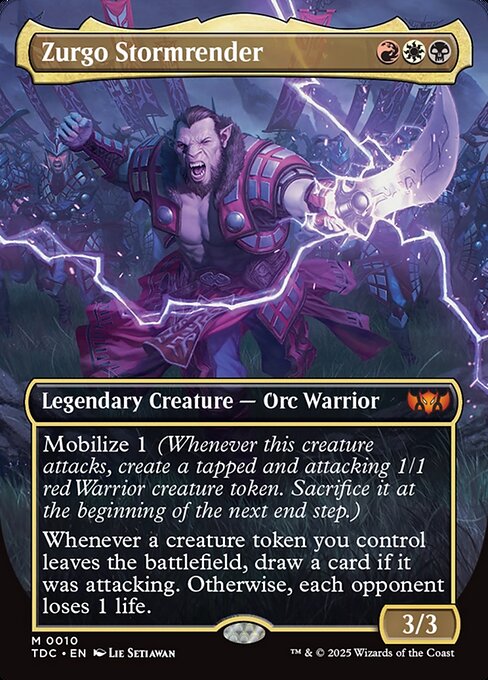
Thirty-three of this box's ninety-nine cards create tokens, and not one of them deals damage when a token arrives. Zurgo Stormrender pays out on the way out — a card or a drain for every token that leaves — and thirteen swaps, about $54, make the way in pay too.
Every figure on this page comes from resolving the shipped Tarkir: Dragonstorm decklist card by card — the land classifications, the pip odds, the token-maker count, the bracket floor. Figures about the deck after the swaps were recomputed on the post-swap list.
 23
23 21
21 20
20Upgraded list: 100 cards, 37 lands (15 basic), 31 creatures, average mana value 2.92. Mana sources: 23 white, 21 black, 20 red. No Game Changers and no mass land denial, so the deck sets no bracket floor. How brackets work →
What are the best Mardu Surge upgrades?
Ranked by how much each one moves this deck. The cuts free the slots.
- Warleader's Call ($6.15) — a permanent +1/+1 for the whole team stapled to a ping at each opponent for every creature that enters. Both halves scale with everything the box already does.
- Mirkwood Bats ($1.43) — triggers when a token is created and again when one is sacrificed, so every Mobilize token drains twice.
- Impact Tremors ($2.21 foil — its default printing is foil-only) — the cheapest possible version of the effect this deck is missing.
- Witty Roastmaster ($1.52) — the same ping on a 3/2 body that can attack alongside the tokens it counts.
- Corpse Knight ($0.69) — one more arrival ping, because redundancy is the plan when the commander supplies the tokens.
- Goblin Bombardment ($2.61) — a free, instant-speed sacrifice outlet. Sacrificing a token mid-combat turns Zurgo's drain into a draw, and the damage goes anywhere.
- Teysa Karlov ($2.67) — when a token dies, Zurgo and Bastion of Remembrance each trigger twice, and every token gains lifelink.
- Anguished Unmaking ($1.37) — instant-speed exile for any nonland permanent, in a box that shipped four spot-removal spells.
Spectator Seating ($5.83), Luxury Suite ($9.16), Vault of Champions ($17.00), Sulfurous Springs ($1.18) and Sundown Pass ($2.37) take over from the five slowest lands. Every pick is argued below.
Thirty-three ways to make a token, no way to spend one
Count the token makers in the 99 and you get 33 — a full third of the deck — before Zurgo adds one more on every attack. Nine of them — plus Mobilize on the commander — make their tokens already tapped and attacking: Ainok Strike Leader and Infantry Shield, the attack triggers on Adeline, Resplendent Cathar and Hero of Bladehold, Redoubled Stormsinger's copies, and myriad from Ironwill Forger, Goldlust Triad, Blade of Selves and Legion Loyalty.
Now count what a token is worth when it enters the battlefield: nothing. The box's payoffs read attacks and exits — Within Range drains per attacker, Mindblade Render and Gix, Yawgmoth Praetor draw when the little bodies connect, Skullclamp and Bastion of Remembrance pay on death. Those are good payoffs. But a deck that manufactures this many bodies wants them to matter the moment they hit the table, and that entire effect category — Impact Tremors and its family — shipped at zero copies. Most of the add list is that family.
The draw is in the timing
Zurgo's second line reads one way in the box insert and two ways at the table: a token that leaves the battlefield while attacking draws you a card; any other token exit makes each opponent lose 1. Which one you get is mostly under your control, and playing this deck well is largely the act of choosing.
Mobilize tokens are sacrificed at the beginning of the end step, after combat is over — those are drains. Myriad copies are exiled at end of combat, while they still count as attacking — those are draws. A token that dies blocked is a draw. A token sacrificed to Viscera Seer, Yahenni, Undying Partisan, Chittering Witch or Deadly Dispute during your combat is a draw; the same sacrifice on someone else's turn is a drain. Attacking into blockers stops being a cost. Every 1/1 that dies on the way in replaces itself.
This is also why the deck's draw count of nine undersells it. Gix, Yawgmoth Praetor and Mindblade Render read the same wide attack — every Mobilize token is a Warrior — and Skullclamp turns any 1/1 into two cards for one mana, as often as you can pay it.
What I'd cut
Legion Loyalty is the one that hurts. Giving every creature myriad in a four-player game is a mass-draw engine with Zurgo, since each exiled copy leaves while attacking. It also costs eight with two white pips and does nothing the turn it resolves, in a list whose average spell now costs under three. If your pod plays long games, this is the first cut to reverse.
Myr Battlesphere brings four Myr for seven mana, and those Myr mostly stand home as tap fodder — exits that drain instead of draw, several turns too late.
Sun Titan asks for six mana with double white — the pip more spells here fight over than any other — to rebuy permanents cheap enough to simply recast.
Eliminate the Competition sacrifices X creatures at sorcery speed, when none of them are attacking — drains, not draws — and spends five mana doing what Anguished Unmaking does for three at instant speed.
Beetleback Chief and Ogre Battledriver both lean on {R}{R}, the pip this mana base covers worst — a turn-three double red resolves at 58% on the play in the stock list. The Chief's two Goblins are Siege-Gang Commander's job done smaller, and the Battledriver's haste is wasted on tokens that enter already attacking, while Goldnight Commander pumps the whole team per arrival instead of one body at a time.
Emeria Angel makes a Bird per land drop in a deck with no extra land drops — the slowest token rate in the box.
Infantry Shield grants Mobilize X, which sounds like the deck's name until you cost it out: three mana, then two to equip, before the first extra token — and those tokens are end-step drains, not damage now.
Canyon Slough, Temple of Silence, Temple of Triumph, Nomad Outpost and Path of Ancestry always enter tapped, in an attack deck that wants mana on curve from turn one. The Path is the closest call, and still isn't close: its scry fires on six creatures in the box plus the commander, and the untapped lands replacing these five fix the same colours without the lost turns.
What I'd add
The payout layer first: Impact Tremors, Witty Roastmaster, Corpse Knight, Warleader's Call and Mirkwood Bats. Do the arithmetic on one Mobilize token with all five on the table: it deals 5 to each opponent arriving and 3 more leaving — Zurgo, Bastion of Remembrance and the Bats again — so a single attack step's free token is worth 8 damage to every opponent. Adeline, Resplendent Cathar makes three tokens per swing in a four-player game; under the full layer that is 15 damage spread around the table before blocks are even declared. You will rarely have all five out. Two is already a clock.
Goblin Bombardment is the piece that makes the timing section above actionable: a sacrifice outlet with no mana cost that works mid-combat, converting any about-to-be-sacrificed token into a draw plus a damage anywhere it helps. Teysa Karlov doubles every trigger a dying token causes — Zurgo's, the Bastion's, the Bats' — and her lifelink line turns a wide attack under Warleader's Call into real life swings. She deliberately does not double the myriad draws; exiled copies never die, and the card is worth the slot anyway.
Anguished Unmaking takes the removal count from four to five, at instant speed, exiling anything from a commander to a stax enchantment for three mana and three life.
The lands: Spectator Seating, Luxury Suite and Vault of Champions enter untapped whenever you have two or more opponents — that is every Commander game — and Sulfurous Springs and Sundown Pass cover the same colour pairs at a life point or a trivial condition. The honest ledger: the colour-source counts barely move — white goes 24 to 23, black 22 to 21, red holds at 20 — but seven always-tapped lands become two, and the two spells demanding double red drop to Grenzo, Havoc Raiser and Siege-Gang Commander after the cuts. What the swap buys is not arithmetic, it's tempo.
The flagged cards that stay
Skullclamp is single-creature equipment in a go-wide deck, which is normally a cut. Here every token is a 1/1, so the +1/−1 is a kill switch: clamp a token, it dies, draw two, re-equip for one. The best card in the box.
Blade of Selves reads clunky at equip {4} until you land it on Hero of Bladehold: two extra Heroes in a four-player game, each bringing two more tapped-and-attacking Soldiers and its own battle cry, and each copy draws a card through Zurgo when it exiles at end of combat — still attacking, so it's the draw mode, every time.
Lightning Greaves protects the one creature the whole payout scheme runs through. Zurgo costs three and will die often anyway; shroud makes often into rarely.
Siege-Gang Commander shows up as a five-drop without evasion or card advantage. It is three tokens and a repeatable outlet that throws 2 damage at anything — and a Goblin sacrificed during your combat is also a card.
Windbrisk Heights and Bojuka Bog are the two tapped lands that keep their slots. Attacking with three creatures is this deck's resting state — Zurgo, his Mobilize token and any body clears the bar — so the Heights' free spell is live nearly every turn, and the Bog is the deck's only graveyard interaction.
The numbers after thirteen swaps
Average mana value falls from 3.21 to 2.92, with 44 spells at three or less against 39 in the box. Always-tapped lands go seven to two of 37. Spot removal moves from four to five, into the typical band. Ramp stays at seven, under the usual eight-to-twelve — a deliberate shortfall, because the curve now peaks at two and the deck would rather cast two payoffs than one rock. The creature count slips from 32 to 31 while legends rise from eight to nine, and neither list carries a bracket signal — no Game Changers, land denial, extra turns or tutors, so nothing forces the deck above Bracket 1. The box's singles run $78.40 and the upgraded list $125.94, both August 2026 prices.
The upgraded decklist
The full 100 after the thirteen swaps. Hover any name for the card and its current price.
“Load into the deck builder” opens this list in your account, pinned to the printings the box shipped, ready to edit or save. “Copy decklist” gives you plain text for Moxfield, Archidekt or Arena — no account needed.
Commander 1
- Zurgo Stormrender
Creatures 30
- Adeline, Resplendent Cathar
- Ainok Strike Leader
- Angel of Invention
- Aron, Benalia's Ruin
- Bone Devourer
- Chittering Witch
- Corpse Knight
- Gix, Yawgmoth Praetor
- Goldlust Triad
- Goldnight Commander
- Grenzo, Havoc Raiser
- Hero of Bladehold
- Ironwill Forger
- Legion Warboss
- Loyal Apprentice
- Mindblade Render
- Mirkwood Bats
- Morbid Opportunist
- Neriv, Crackling Vanguard
- Ophiomancer
- Redoubled Stormsinger
- Selfless Spirit
- Siege-Gang Commander
- Solemn Simulacrum
- Teysa Karlov
- Thalisse, Reverent Medium
- Twilight Drover
- Viscera Seer
- Witty Roastmaster
- Yahenni, Undying Partisan




Planeswalkers 1
- Kaya, Geist Hunter
Instants 8
- Abrade
- Anguished Unmaking
- Bitter Triumph
- Deadly Dispute
- Grand Crescendo
- Stroke of Midnight
- Swords to Plowshares
- Will of the Mardu

Sorceries 5
- Hour of Reckoning
- Lingering Souls
- Release the Dogs
- Shadow Summoning
- Tempt with Vengeance
Artifacts 10
- Arcane Signet
- Blade of Selves
- Fellwar Stone
- Idol of Oblivion
- Lightning Greaves
- Skullclamp
- Sol Ring
- Talisman of Conviction
- Talisman of Hierarchy
- Wayfarer's Bauble
Enchantments 8
- Bastion of Remembrance
- Commander's Insignia
- Divine Visitation
- Goblin Bombardment
- Impact Tremors
- Tocasia's Welcome
- Warleader's Call
- Within Range
Lands 37
- Battlefield Forge
- Bojuka Bog
- Castle Ardenvale
- Castle Embereth
- Caves of Koilos
- Clifftop Retreat
- Command Tower
- Dragonskull Summit
- Exotic Orchard
- Fetid Heath
- Isolated Chapel
- Luxury Suite
- 5× Mountain
- 5× Plains
- Shattered Landscape
- Shattered Sanctum
- Smoldering Marsh
- Spectator Seating
- Sulfurous Springs
- Sundown Pass
- 5× Swamp
- Terramorphic Expanse
- Vault of Champions
- Vault of the Archangel
- Windbrisk Heights
FAQ
How good is Mardu Surge before any upgrades?
The token supply is genuinely deep — 33 of the 99 cards create at least one token — and the box's singles run $78.40 at August 2026 prices. What it lacks is conversion: no card in the shipped list deals damage when a token enters, and seven of its 37 lands always arrive tapped.
What do the thirteen adds cost?
About $54 at August 2026 market prices: $51.98 for twelve of the cards at their default printings, plus $2.21 for Impact Tremors, whose default printing is foil-only. Vault of Champions at $17.00 is the single biggest line; the eight nonland adds together come to $18.65.
Why does the swap list skip token doublers?
Price, not merit. Anointed Procession ($61.26) costs more than this page's entire thirteen-card add list combined, and Mondrak, Glory Dominus ($40.52) is close behind — either is the right first purchase beyond this list. The box also already doubles a key turn on its own: Kaya, Geist Hunter's −2 doubles every token you make for the rest of that turn.
Can Neriv, Crackling Vanguard lead Mardu Surge instead?
Yes — Neriv is the box's second commander and shares the R/W/B identity. The attack trigger exiles cards equal to the number of differently named tokens you control, and the stock list can produce tokens under seventeen different names, from Warriors and Goblins to Treasures and Thopters — exiling three or four cards a swing is realistic. Zurgo stays the stronger engine because he pays off every token, not just the attack.
Which bracket does Mardu Surge land in?
Neither list sets a bracket floor — no Game Changers, mass land denial, extra turns, or nonland tutors, so nothing forces it above Bracket 1. In practice it plays like a typical Bracket 2 precon table. Paste your own version into the bracket checker to see what changes that.