Witherbloom Pestilence precon upgrade guide
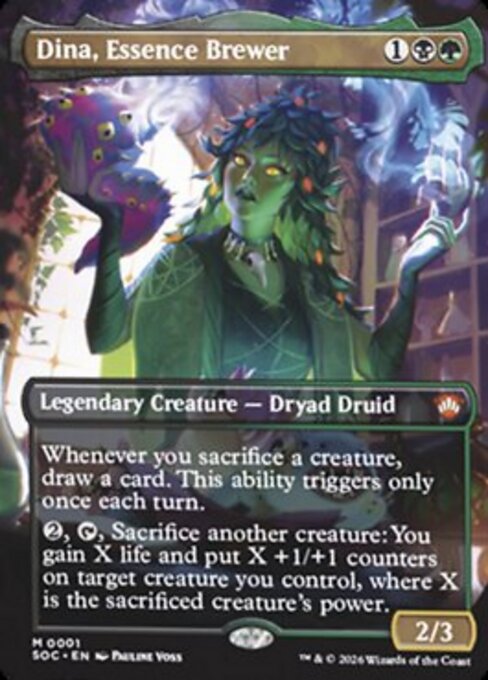
The box gives Dina, Essence Brewer four ways to sacrifice a creature for free and two cards that make anybody lose life for it.
That gap is the whole guide. Secrets of Strixhaven ships this deck with a working sacrifice engine — seven cards that make a creature token at the beginning of an upkeep, an eighth that makes one at your end step, four sacrifice outlets you can use without paying mana — and then almost nothing on the other end to convert the deaths. Blood Artist and Zulaport Cutthroat are the only two cards in the ninety-nine that drain an opponent when a creature dies. Everything else in the box gains you life, draws you a card, or puts a counter on something.
So the swaps below spend most of their budget on the back half of the engine, and the rest on getting the deck to cast its two-drops on turn two. Every number on this page comes from resolving the shipped decklist card by card and running it through the same hypergeometrics as the mana base calculator; where a figure describes the box rather than the list I am recommending, I say “stock”.
 31
31 30
30Upgraded list: 100 cards, 37 lands (16 basic), 39 creatures, average mana value 2.85. Mana sources: 31 black, 30 green. No Game Changers and no mass land denial, so the deck sets no bracket floor. How brackets work →
What are the best Witherbloom Pestilence upgrades?
Seven cards, in the order I would buy them. Each is argued further down.
- Ashnod's Altar — a free sacrifice outlet that pays you two colourless for the privilege. Dina, Essence Brewer's own outlet costs {2} and a tap; this one costs nothing and turns the token engine into ramp.
- Bastion of Remembrance — the third unconditional drain, and the only one that is an enchantment. The box's two drains are both creatures, so both die to the deck's own Final Act.
- Carrion Feeder — one mana, free to activate, and it grows every time you feed it. It takes the count of no-cost outlets from four to six.
- Deadly Dispute — one black and a body for two cards and a Treasure. The stock list draws off deaths three times; this makes it four, and it is the cheapest of them by three mana.
- Overgrown Tomb, Blooming Marsh and Deathcap Glade — three untapped duals. Seven lands in the box enter tapped unconditionally; these are most of why that number ends up at three.
- Poison-Tip Archer — a drain payoff in green, which matters because eleven of the box's cards already want two black pips by turn three and the mana cannot pay all of them.
- Grim Haruspex — three mana, draws on every nontoken death, and it does not cap at one per turn the way the commander does.
The rest, and what comes out for them, is further down the page. None of it is on the Game Changers list, so the deck keeps the Bracket 1 floor it shipped with.
The commander draws once a turn, and that changes what an outlet is worth
Read Dina, Essence Brewer carefully. “Whenever you sacrifice a creature, draw a card. This ability triggers only once each turn.” The second sentence decides how this deck is built: sacrificing five creatures in a turn draws exactly one card, so an outlet is not paying you in cards after the first activation. It is paying you in whatever the outlet itself does.
That is why the four free outlets matter more than their individual text boxes suggest. Viscera Seer scrys, Woe Strider scrys, Umbral Collar Zealot surveils, and Yahenni, Undying Partisan makes itself indestructible — none of that is spectacular, but all four cost nothing, so the fifth sacrifice of the turn is still free. Four more outlets exist and every one is gated: Wight of the Reliquary and Priest of Forgotten Gods want a tap, High Market wants a tap and hands you one life, Grim Backwoods wants {2}{B}{G} plus a tap, and Dina, Soul Steeper wants {1}. The commander is the most expensive outlet in the deck at {2}, a tap and a creature.
Three cards turn deaths into cards without asking anything of you: Smothering Abomination, Morbid Opportunist and Moldervine Reclamation. Morbid Opportunist carries the same once-a-turn clause the commander does. Moldervine Reclamation does not, and costs five.
Two cards make the deaths hurt, and both die to your own board wipe
Blood Artist and Zulaport Cutthroat. That is the list. In a deck whose commander asks you to sacrifice a creature every single turn, and which can generate a token every upkeep from seven different cards, two drain effects is not enough on the receiving end — and both are two-mana creatures, so Toxic Deluge and Final Act take them along with everything else.
Bastion of Remembrance fixes the shape of that problem, not just the count. It reads like Blood Artist, it comes with a token, and a wipe leaves it on the table. Poison-Tip Archer adds a fourth drain in green, on a body that also blocks. Pitiless Plunderer turns each death into a Treasure, which is what lets you activate the commander and still cast something.
The lifegain half of the box is real, and worth being precise about rather than dismissive. Eight cards check whether you gained life this turn. Defiling Daemogoth drains for it, Witch of the Moors makes each opponent sacrifice for it, Trudge Garden makes a 4/4 for it, Veinwitch Coven buys back a creature for it, Blossoming Bogbeast pumps the team for it, Mortality Spear costs two less for it, Eccentric Pestfinder prepares for it, and Dina, Soul Steeper converts each instance of it into damage. The commander's activated ability gains X life, so the two halves genuinely connect.
They connect through an ability that costs {2}, a tap and a creature, once per turn.
Seven lands enter tapped, and one more makes the wrong colour
Stock, the mana base is 37 lands with 16 basics: 26 enter untapped, 4 are conditional, and 7 enter tapped no matter what. That last group is Festering Thicket, Temple of Malady, Titan's Grave, Bojuka Bog, Haunted Mire, Path of Ancestry and Witherbloom Campus.
Conditional is not the same as tapped, and the four here are mostly fine. Vernal Fen wants two basic lands and the deck runs sixteen. Woodland Cemetery wants a Swamp or a Forest and the deck runs sixteen of those too. Necroblossom Snarl wants you to reveal one from hand. Turbulent Fen is the odd one out — it enters untapped only when your opponents control eight or more lands, so it is a tapland on the turns you care about and untapped around turn eight. All four stay.
Study Hall is the land worth singling out, because it appears on no tapland list and is still the weakest land in the box. It taps for one colourless. Getting a coloured mana out of it costs an additional {1}, and coloured mana is exactly this deck's problem: eleven cards want {B}{B} by turn three, and the box has 29 black sources against the 36 that would make that a 90% proposition. It comes up 7 short, at 80.4%. Green is 5 short on {G}{G} by turn four, at 83.7%.
Path of Ancestry has the same problem in reverse. It taps for any colour in the identity, which is genuinely useful, but its scry only fires on a creature sharing a type with Dina, Essence Brewer — a Dryad or a Druid — and 7 of the deck's 40 creatures qualify. No creature type in this box reaches even 20%: 7 Druids, 7 Vampires, 7 Humans, 4 Dryads, 4 Warlocks, 4 Shamans. There is no typal plan here to build toward, which is a perfectly fine thing for a goodstuff sacrifice deck to be. It does mean that land is a tapland with a rider that mostly does not happen.
Swapping in Overgrown Tomb, Blooming Marsh, Deathcap Glade, Darkbore Pathway and Nurturing Peatland moves black from 29 sources to 31 and green from 28 to 30, and takes always-tapped from 7 to 3. The double-pip gap narrows rather than closing: {B}{B} by turn three goes from 7 short to 5 short, 80.4% to 83.9%. Nothing you can reasonably buy for this deck closes it completely, and I would rather say so than pretend five untapped duals fixed the mana. If you want to chase the rest, the honest lever is more basics, and the double-pip sources tool will price out what each one buys you.
Twelve cards cost five or more, and the engine costs two
Stock average mana value is 3.05, which sounds tame until you see where the cards actually sit: 20 at two, 17 at three, then a bulge of 9 at five, 2 at six and 1 at seven. The two-drops are the deck — Viscera Seer, Blood Artist, Zulaport Cutthroat, Jadar, Ghoulcaller of Nephalia, Morbid Opportunist — and the five-drops are mostly a second deck stapled on top of it.
Four of those twelve come out below. Casualties of War is the clearest case: it costs {2}{B}{B}{G}{G}, and it is one of only three cards in the box demanding a double pip in both colours at once. Cutting it removes a name from the black shortfall list and the green one in a single swap.
What I'd cut
Twelve, and the count is not a target — it is where the argument ran out. The stock list produced thirteen candidates worth arguing about and I disagreed with one of them.
- Casualties of War — six mana, four coloured pips, and on both double-pip shortfall lists.
- Tendershoot Dryad — five mana that makes a 1/1 next upkeep. The Saprolings are fodder, but you are paying five for the first one.
- Ribtruss Roaster — devour 1 asks you to sacrifice creatures at the worst possible moment: on the way in, with no death triggers on the board yet.
- Blossoming Bogbeast — five mana that wants to attack. This deck's damage comes from drain, not combat.
- Gyome, Master Chef — Food tokens are artifacts. None of the deck's four free sacrifice outlets can eat one, and only Umbral Collar Zealot can eat one at all.
- Merchant of Venom — four mana for a 3/3 with menace and a one-shot edict. Fine, and the slot is worth more.
- Feral Appetite — three mana whose real value is a {1}{G} activation to exile a card and make a Pest. That is a lot of mana per body in a deck already making one a turn for free.
- Study Hall — taps for colourless in a deck five to seven sources short on double pips.
- Path of Ancestry — always tapped, and the scry needs one of 7 creatures out of 40.
- Festering Thicket, Haunted Mire and Witherbloom Campus — always tapped. The Thicket cycles for {2}, the Campus scrys for {4}, and the Mire does nothing at all.
What I'd add
- Ashnod's Altar — free outlet, and two colourless per creature. It is the most expensive card on this list by a distance; Bloodflow Connoisseur or Nantuko Husk is the budget version of the outlet, and neither gives you the mana.
- Carrion Feeder — one mana, free activations, and it eats its way into being a real threat.
- Bastion of Remembrance — the drain effect that survives your own wipes.
- Poison-Tip Archer — drain number four, deathtouch reach, and a green card in a deck whose black requirements are already oversubscribed.
- Pitiless Plunderer — a Treasure per nontoken death, which is how you pay for the commander's ability and still cast a spell.
- Grim Haruspex — draws on every nontoken death, with no once-a-turn clause.
- Deadly Dispute — two cards and a Treasure for {1}{B} and a creature you were sacrificing anyway.
- Overgrown Tomb, Blooming Marsh, Deathcap Glade, Darkbore Pathway and Nurturing Peatland — five lands that are untapped when it matters. Blooming Marsh covers the first three turns, Deathcap Glade covers everything after, and Darkbore Pathway lets you pick whichever colour you are short on that game.
Village Rites and Midnight Reaper were the next two out. Phyrexian Altar is the upgrade to Ashnod's Altar if the budget stops mattering, and Sifter of Skulls is the version of Pitiless Plunderer that makes bodies instead of Treasures. Nadier's Nightblade nearly made it on the strength of the token count, and lost to Poison-Tip Archer for being one more black double-pip.
The cards that look like cuts and aren't
Five candidates survive into the upgraded list, and each deserves an answer.
Mycoloth costs five and does nothing the turn it lands, which is the standard objection. It is also the best fodder engine in the box: devour whatever is already dying, then make that many 1/1s every upkeep. In a deck built to sacrifice a creature per turn, that is the card that means you never miss a turn.
Witch of the Moors is a five-drop with no evasion. It is also an edict on every opponent at every end step you gained life, plus a creature back from the graveyard — and eight cards in the box are already checking that same lifegain condition, so it is rarely a dead trigger.
Bojuka Bog, Temple of Malady and Titan's Grave all enter tapped and all three stay. The Bog exiles a graveyard, which is the deck's only graveyard hate and matters in a format this full of recursion. The Temple scrys. Titan's Grave surveils for {2}{B}{G}, which is expensive, but it also makes both colours. Three unconditional taplands out of 37 is a number I am comfortable with. Seven was not.
What the twelve swaps actually move
Average mana value drops from 3.05 to 2.85. Cards costing five or more go from 12 to 8. Always-tapped lands go from 7 to 3, conditional from 4 to 7, and untapped from 26 to 27, on the same 37-land count. Black sources go 29 to 31 and green 28 to 30, which moves the {B}{B}-by-turn-three check from 80.4% to 83.9% and {G}{G}-by-turn-four from 83.7% to 86.9%. Card draw goes from 8 pieces to 10, and ramp from 9 to 10.
One number goes the wrong way. Spot removal drops from 8 to 6, because Casualties of War and Feral Appetite both counted and neither replacement is removal. Six is still inside the range I would want, and Toxic Deluge and Final Act stay as sweepers, but if you cut differently that is the number to watch.
The bracket does not move. Nothing in this list is a Game Changer, and the deck adds no mass land denial, extra turns or nonland tutors, so the upgraded list still sets a Bracket 1 floor. You can check that for yourself — and for whatever you build instead — with the bracket checker.
The upgraded decklist
All 100 cards, grouped by role. Hover any name to see the card and its current price.
“Load into the deck builder” opens this list in your account, pinned to the printings the box shipped, ready to edit or save. “Copy decklist” gives you plain text for Moxfield, Archidekt or Arena — no account needed.
Commander 1
- Dina, Essence Brewer

Creatures 38
- Beledros Witherbloom
- Blood Artist
- Bloodghast
- Carrion Feeder
- Creakwood Liege
- Defiling Daemogoth
- Dina, Soul Steeper
- Eccentric Pestfinder // Turn Stones
- Elvish Mystic
- Gilded Goose
- Gorma, the Gullet
- Grim Haruspex
- Haywire Mite
- Jadar, Ghoulcaller of Nephalia
- Mazirek, Kraul Death Priest
- Morbid Opportunist
- Mycoloth
- Nether Traitor
- Ohran Frostfang
- Ophiomancer
- Pawn of Ulamog
- Pest Rescuer
- Pitiless Plunderer
- Poison-Tip Archer
- Priest of Forgotten Gods
- Sakura-Tribe Elder
- Smothering Abomination
- Springbloom Druid
- Stensian Sanguinist // Exsanguinate
- Teacher's Pest
- Umbral Collar Zealot
- Veinwitch Coven
- Viscera Seer
- Wight of the Reliquary
- Witch of the Moors
- Woe Strider
- Yahenni, Undying Partisan
- Zulaport Cutthroat





Instants 6
- Assassin's Trophy
- Deadly Dispute
- Infernal Grasp
- Mortality Spear
- Plumb the Forbidden
- Witherbloom Charm
Sorceries 10
- Culling Ritual
- Cultivate
- Deadly Brew
- Final Act
- Immoral Bargain
- Night's Whisper
- Ominous Harvest
- Pest Infestation
- Toxic Deluge
- Witherbloom Command

Artifacts 3
- Arcane Signet
- Ashnod's Altar
- Sol Ring
Enchantments 5
- Awakening Zone
- Bastion of Remembrance
- Blight Mound
- Moldervine Reclamation
- Trudge Garden
Lands 37
- Blooming Marsh
- Bojuka Bog
- Command Tower
- Darkbore Pathway // Slitherbore Pathway
- Deathcap Glade
- Exotic Orchard
- Fabled Passage
- 8× Forest
- Grim Backwoods
- High Market
- Llanowar Wastes
- Necroblossom Snarl
- Nurturing Peatland
- Overgrown Tomb
- 8× Swamp
- Temple of Malady
- Terramorphic Expanse
- Titan's Grave
- Turbulent Fen
- Twilight Mire
- Vernal Fen
- Viridescent Bog
- Woodland Cemetery
FAQ
Is Witherbloom Pestilence a good deck out of the box?
It is a complete deck that does what it says: 40 creatures, seven cards that make a token at the beginning of an upkeep, and enough sacrifice outlets to use the commander every turn. What it does not have is a way to close a game. Two cards drain an opponent when a creature dies, and both cost two mana and die to a board wipe. Out of the box you will grind well and win slowly.
Why does sacrificing five creatures only draw one card?
Because Dina, Essence Brewer's first ability says “This ability triggers only once each turn.” The draw is one per turn no matter how many creatures you sacrifice, which is why a free sacrifice outlet in this deck is valued for what the outlet itself does — a scry, a surveil, indestructibility, mana — and not for the cards.
Which sacrifice outlets are already in the box?
Four you can use without paying mana: Viscera Seer, Woe Strider, Umbral Collar Zealot and Yahenni, Undying Partisan. Four more are gated behind a tap or mana: Wight of the Reliquary, Priest of Forgotten Gods, High Market and Grim Backwoods, plus Dina, Soul Steeper for {1}. The commander is the most expensive of them at {2}, a tap and a creature.
Does this deck need to gain life to function?
Not to function, but eight cards in the box are checking. Defiling Daemogoth, Witch of the Moors, Trudge Garden, Veinwitch Coven, Blossoming Bogbeast, Mortality Spear, Eccentric Pestfinder and Dina, Soul Steeper all ask whether you gained life this turn. Every Pest token gains you a life when it dies, so the condition is usually met. It is the payoffs that are thin, not the triggers.
Why cut Path of Ancestry from a 40-creature deck?
Its scry only fires when that mana casts a creature sharing a type with your commander. Dina, Essence Brewer is a Dryad Druid, and 7 of the deck's 40 creatures are Dryads or Druids. No creature type in the box reaches 20%, so the land is an always-tapped dual with a rider that fires under a fifth of the time.
How many lands does the upgraded list run?
37, the same as the box, with 16 basics. What changes is how they enter: 27 untapped, 7 conditional and 3 always tapped, against a stock split of 26, 4 and 7. Average mana value also drops from 3.05 to 2.85, so 37 stays comfortable.
Do any of these upgrades change the deck's bracket?
No. Nothing added here is on the Game Changers list, and the list adds no mass land denial, extra turns or nonland tutors, so the upgraded deck still sets a Bracket 1 floor, the same as the stock deck.
What is the cheapest upgrade that makes the biggest difference?
Bastion of Remembrance and Deadly Dispute. One is a third drain effect that survives a board wipe, the other is the cheapest death-triggered draw the deck can run, and both are among the least expensive cards on the add list. Ashnod's Altar is the strongest single card here and costs many times either of them.