Quandrix Unlimited precon upgrade guide
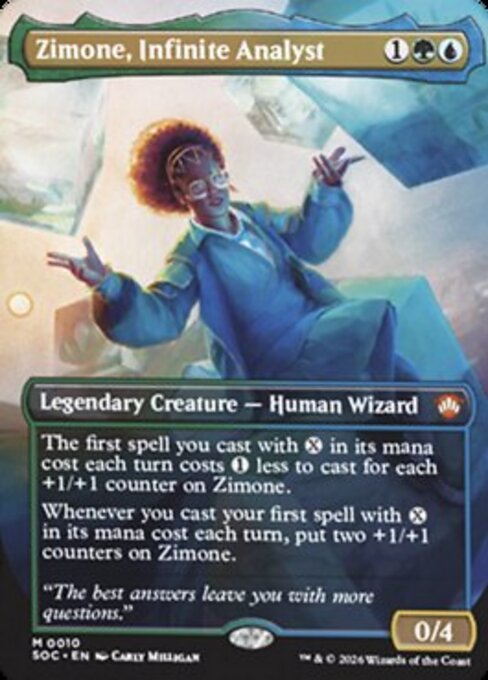
Zimone, Infinite Analyst discounts one spell a turn, and the box handed her twenty-nine candidates.
Twenty-nine of the sixty-two nonland cards in Quandrix Unlimited have {X} in their mana cost. Two more carry it on a back face. That is a startling density — and Zimone only ever discounts the first one you cast each turn. Every X spell after the first pays full retail, which means the twenty-ninth X card in the deck is worth a fraction of the tenth, and swapping the weakest of them out for cards that make the discount bigger costs almost nothing.
That's the whole argument of this guide, and everything below is worked from the shipped decklist, resolved card by card.
 30
30 31
31Upgraded list: 100 cards, 37 lands (13 basic), 28 creatures, average mana value 2.44. Mana sources: 30 blue, 31 green. No Game Changers and no mass land denial, so the deck sets no bracket floor. How brackets work →
What are the best Quandrix Unlimited upgrades?
If you only buy five cards, buy these, in this order. Each one is argued further down.
- Branching Evolution — the box already ships four effects that add one extra counter to every placement. This one doubles the total, and stacked last it turns Zimone's own two-counter trigger into twelve.
- Inexorable Tide — proliferate on every spell you cast, which is how the cards without {X} in their cost start growing the discount too.
- Swiftfoot Boots — the discount lives on Zimone as counters, and it resets to zero the moment she dies. Hexproof for {2} and an equip of {1}.
- Vorel of the Hull Clade — {G}{U} and a tap to double the counters on Zimone, every turn. It doubles the charge counters on Astral Cornucopia and Elementalist's Palette too.
- Garruk's Uprising — six Hydras in the upgraded list enter with X counters on them, and this draws a card for each one that lands at power 4 or better. It gives the board trample as well.
All thirteen swaps, plus what comes out for them, are further down the page. Nothing on the list is a Game Changer, so the deck keeps its Bracket 1 floor.
What the stock deck actually looks like
Every figure here comes from the shipped decklist, resolved card by card:
- 29 of the 62 nonland cards have {X} in their mana cost. Two more — Striding Shotcaller and Elusive Otter — carry it on a back face.
- 31 cards mention +1/+1 counters, but about half of those only ever put counters on themselves or on a token they just made.
- 28 creatures, 7 of them Hydras. No creature type reaches half the board, so there is nothing typal to build toward here.
- 37 lands, 13 basic. 26 enter untapped no matter what, 4 have a condition, and 7 always enter tapped.
- Average mana value 2.39, with nothing in the deck costing more than five. That number is a polite fiction: an {X} spell is priced at its pips, and the real cost is whatever you pour into X.
- Green and blue sit at 30 sources each. Single pips are comfortable at 95.1% by turn two; double pips by turn three land at 82.2%.
- Bracket 1 floor. No Game Changers, no mass land denial, no extra turns, no tutors.
One number I want to correct before it misleads anyone. Tally only the cards that print a mana symbol and this deck looks starved for ramp at seven. Count the land fetchers too and it ships thirteen ways to make extra mana or put an extra land down: Sol Ring, Arcane Signet, Astral Cornucopia, Elementalist's Palette, Brass Infiniscope, Kami of Whispered Hopes, Troyan, Gutsy Explorer, Nature's Lore, Three Visits, Open the Way, Animist's Awakening, Mana Bloom and Zimone, Quandrix Prodigy. Ramp is not this deck's problem, and I haven't added any.
The discount is once a turn, and only Zimone's own counters pay for it
Read the commander slowly, because both halves have a limiter in them.
The first spell you cast with {X} in its mana cost each turn costs {1} less to cast for each +1/+1 counter on Zimone. Whenever you cast your first spell with {X} in its mana cost each turn, put two +1/+1 counters on Zimone.
Two things fall straight out of that. The second X spell you cast in a turn gets nothing, so a deck packed to 29 of them is holding a lot of cards competing for one slot. And the discount is stored on a single creature, in counters, so it grows only while she's alive and it goes back to zero if she isn't.
The two counters also arrive when you cast the spell, not before you pay for it, so whatever discount you use on a given turn was banked on earlier ones. Zimone resolving on turn three does nothing for your turn-three X spell.
Now the part that makes the deck worth building. Four cards in the box add one to every batch of counters placed on a creature you control:
- Hardened Scales — any creature you control.
- Ozolith, the Shattered Spire — any artifact or creature you control, and it can add one itself for {1}{G} at sorcery speed.
- Kami of Whispered Hopes — any permanent you control, and it taps for mana equal to its own power.
- Benevolent Hydra — every other creature you control, which includes Zimone.
Each of those is a replacement effect, each applies once, and you pick the order. With all four out, Zimone's two counters become six. Add Branching Evolution and apply it last and they become twelve.
Twelve counters is {12} off the first X spell on your next turn, and Zimone reduces generic mana only, so what that buys is precise: Primordial Hydra for {G}{G} with X set to 12, which then doubles its own counters every upkeep.
What none of that touches is the other half of the counter cards. Nev, the Practical Dean puts X counters on Nev when you cast your first X spell, not on Zimone. The seven Hydras enter with counters on themselves. Deekah, Fractal Theorist and Lattice Library make tokens and load the counters onto those. All of it is fine. None of it makes your spells cheaper.
Cast your biggest X spell first
Four cards besides the commander are keyed to the same phrase, and they're worth knowing as a group because together they turn the order of your turn into a real decision:
- Owlin Spiralmancer copies your first X spell each turn. The copy isn't cast, so it consumes nothing.
- Lattice Library makes a Fractal sized to its study counters on your first X spell each turn.
- Nev, the Practical Dean takes X counters on your first X spell each turn.
- Brass Infiniscope draws a card and gains half X life on the next X spell after you tap it.
Every one of those keys off the first one, and so does the discount. Lead with the biggest X you can afford and let the small ones follow. The reverse costs you a copy, a Fractal, a fistful of counters and a card, all in the same turn.
Six of the thirty-seven lands can't cast a green or blue spell
This is where the box actually loses time, and it isn't the taplands.
Four lands tap for colourless and nothing else: Alchemist's Refuge, Reliquary Tower, Rogue's Passage and Temple of the False God. Two more, Study Hall and Opal Palace, will make a coloured mana but charge an extra {1} for it. Six of thirty-seven lands, then, that do nothing toward casting Zimone, Infinite Analyst on turn three — and that is why green and blue both sit at 30 sources.
Feed those counts to the same hypergeometrics behind this site's calculators and the picture splits cleanly. Single pips are fine: 95.1% to have one green and one blue by turn two. Double pips are the gap. {G}{G} and {U}{U} by turn three both come in at 82.2%, against the 36 sources you'd want for 90%. Ten cards ask for {G}{G} and nine ask for {U}{U}, and Biomass Mutation is on both lists because its hybrid pips count either way.
The tapland count, meanwhile, reads worse than it plays. Seven lands always enter tapped and I'm cutting three of them — but Turbulent Wilderness is not one of the seven and shouldn't be treated like one. It enters tapped only until your opponents control eight lands between them, and in a four-player game three opponents cross eight around turn three. It's a tapland in your opening hand and an untapped dual for the rest of the game. Sodden Verdure wants two basics and the deck runs thirteen. Hinterland Harbor wants a Forest or an Island, and between the basics and the three Forest Islands there are sixteen of those.
After the swaps, always-tapped drops from seven to four, untapped goes from 26 to 27, green climbs to 31 sources and 83.9% on {G}{G}, and blue holds at 30 and 82.2%. The land count stays at 37, which is right for a deck that would happily spend twenty mana if you gave it that much.
One honest footnote on that green figure. It counts Yavimaya, Cradle of Growth as a single source, and it isn't one. It makes every land a Forest, so once it's down all thirty-seven of yours tap for green. It also makes your opponents' lands Forests, which matters at a table with another green deck, and it's comfortably the most expensive card I'm recommending. If that's out of budget, the free version of the same fix is cutting one more colourless land for a basic Forest: the deck runs only six, and both Nature's Lore and Three Visits need one to find.
Want these numbers for your own build? The Deck Mana Audit grades every coloured cost in a decklist — it's what put a figure on the double-pip gap above — and the bracket checker tells you the floor your version can honestly claim. No account, nothing stored.
What I'd cut
Thirteen cards: eight spells and five lands. Five of the eight spells have {X} in their cost, which is the point — this deck can afford to lose X spells and can't afford to lose much else.
Two bounce spells that undo your own work
Perplexing Test returns either all creature tokens or all nontoken creatures to their owners' hands. Play it in a deck whose entire plan is accumulating counters and read what the second mode does to your own board: every Hydra goes back to hand as a card with no counters on it, and Zimone goes back to your hand or the command zone with the discount reset. It kills nothing, and the opponent who was ahead replays their board next turn.
Zimone's Hypothesis has the same problem with an extra layer of chance on top. It bounces every creature whose power is odd, or every creature whose power is even — and in this deck power is whatever the counters happened to add up to. You are not aiming that spell so much as rolling it.
Five X spells that will never be the one you cast
Every card here is competing for one slot a turn against a Hydra that wants twelve mana poured into it. These are the five that lose that comparison every time.
Fractal Harness costs {X}{2}{G} to make a 0/0 with X counters and bolt an Equipment to it. Remove the creature in response to anything and you've spent an X spell on an Equipment with equip {2} and no legal body to hold it. Primal Might is a one-shot fight spell, and Animist's Awakening needs a genuinely large X before it beats a two-mana land fetch — at which point you'd rather have cast the Hydra.
Mana Bloom is the strangest one in the box. It's an X spell that produces exactly one mana per turn, and when the charge counters run out it bounces itself to your hand so you can pay for it again.
Steelbane Hydra is the deck's artifact and enchantment answer, and to use it you have to remove a counter from your own creature and pay {2}{G} on top. I want that effect at a fixed price, which is what Krosan Grip is for.
One two-drop that stops mattering
Quandrix Apprentice looks at the top three and takes a land. In a deck with 37 lands and thirteen other ways to find mana, that's a card which is useful for four turns and then a 2/1.
Five lands
Temple of the False God makes no coloured mana and does nothing at all until you control five lands, which is the definition of a card that's worst when you most need help. Rogue's Passage is another colourless land, and this deck already gets through blockers: Nev, the Practical Dean gives trample to everything with a counter on it, and Garruk's Uprising gives it to everything else.
Then three of the seven unconditional taplands, chosen by what they give back for the tempo. Paradox Gardens charges {2}{G}{U} to surveil 1. Quandrix Campus charges {4} to scry 1. Tangled Islet has no ability whatsoever. The four I'm keeping all pay for the tapped turn: Temple of Mystery scries on the way in, Rain-Slicked Copse cycles for {2} when you're flooded, Path of Ancestry makes any colour in the identity, and Oran-Rief, the Vastwood is doing something else entirely, which I'll come back to.
What I'd add
Multiply the counters
Branching Evolution is the single best card you can put in this deck. It's the fifth replacement effect in a stack that already has four, and because you choose the order, you resolve the four that add one and then double the result. Two counters a turn becomes twelve.
Vorel of the Hull Clade is the same idea on demand: {G}{U} and a tap doubles every kind of counter on a target artifact, creature or land. Point it at Zimone the turn before you want a big X spell. It also doubles charge counters, which matters more than it sounds — Elementalist's Palette gains two charge counters every time you cast an X spell and taps for one colourless per counter, spendable only on costs containing {X}. There are 24 of those left in the deck after the swaps.
Inexorable Tide and Evolution Sage attack the problem from the other side. 38 of the 62 nonland cards have no {X} in their cost and therefore contribute nothing to the discount; proliferate is how they start to. Inexorable Tide fires on every spell you cast, full stop, and it's the more expensive of the two in both senses — five mana in a deck with only four other cards at five. Evolution Sage fires on every land that enters, and the deck puts down more than one a turn fairly often between Nature's Lore, Three Visits, Open the Way, Eureka Moment and Zimone, Quandrix Prodigy. If you want only one, take the Sage and spend the difference on a land. If you want proliferate on noncreature spells for a dollar, Flux Channeler does most of the Tide's job.
The card I'm deliberately not recommending is Doubling Season. It's better than Branching Evolution here — it doubles the Fractal tokens too — and it costs several times as much. It's the upgrade you make later, not the one that makes the deck work.
Keep her alive, without shroud
Swiftfoot Boots, and specifically not Lightning Greaves. The Greaves grant shroud, and shroud means you can't target her either — which switches off Ozolith, the Shattered Spire's activation, Vorel of the Hull Clade, Tanazir Quandrix's enter trigger, Nexus Mentality and Quandrix Command. Every one of those exists to put counters on Zimone. The Boots cost {1} more to equip and keep all of it.
Two answers at a fixed price
The box has four ways to deal with a permanent, and one of them is Steelbane Hydra, which can't touch a creature. Pongify destroys any creature for {U}, which is the cheapest unconditional answer blue has and the right price for a deck that would rather spend its mana on X. Krosan Grip takes over the artifact and enchantment job at a flat {2}{G}, and split second means the thing you're killing doesn't get to respond. Spot removal goes from four to five.
Draw off the Hydras
Garruk's Uprising draws a card whenever a creature with power 4 or greater enters under your control. The upgraded list has six Hydras that enter with X counters on them, plus Primo, the Unbounded, which enters with twice X. It also hands the whole board trample, which is what you want when your plan is one enormous creature.
Five lands
Breeding Pool, Botanical Sanctum, Barkchannel Pathway // Tidechannel Pathway and Waterlogged Grove all produce green or blue and all of them can enter untapped. Botanical Sanctum is the pointed one: it enters untapped whenever you control two or fewer other lands, which is exactly turns one through three, which is when you're trying to cast a three-mana commander. Breeding Pool is also a Forest Island, so Nature's Lore and Three Visits can fetch it, and you still get to pay the 2 life to have it arrive untapped.
Yavimaya, Cradle of Growth is the fifth, and it's the one to skip if the budget is tight. It's discussed above; the short version is that it turns all 37 of your lands into green sources and does the same for everyone else's.
The cards that look like cuts and aren't
Four cards in the box read like filler and aren't, and I'd rather say why than leave them looking overlooked.
Deekah, Fractal Theorist is a five-drop, which is a fair complaint in a deck averaging 2.39. Here's what saves it: 27 of the cards in the box are instants and sorceries, and Deekah's Fractal enters with counters equal to that spell's mana value. An X spell's mana value on the stack includes the X you paid. Cast a {X}{G}{G} Hydra with X set to 6 and Deekah quietly hands you an 8/8 next to it.
Benevolent Hydra reads like one more X creature in a deck with too many. It is also one of the four cards that add an extra counter to every placement, and the one that reaches Zimone by saying "another creature you control". It's a quarter of the engine.
Tyvar's Stand is a one-mana pump spell in a 28-creature deck, which normally makes it the first cut. Not when your commander is a bank vault. Hexproof and indestructible at instant speed, for one mana, on the creature that stores your entire discount — that's protection, filed under the wrong card type.
Oran-Rief, the Vastwood always enters tapped and taps only for green, and I'm keeping it anyway. Its ability puts a +1/+1 counter on each green creature that entered the battlefield this turn, and Zimone is green. Play her, tap it, and she starts with a counter on her before she's ever triggered.
The upgraded decklist
The full 100, with the thirteen swaps applied. Hover any card name on this page to see the card and its current price.
“Load into the deck builder” opens this list in your account, pinned to the printings the box shipped, ready to edit or save. “Copy decklist” gives you plain text for Moxfield, Archidekt or Arena — no account needed.
Commander 1
- Zimone, Infinite Analyst

Creatures 27
- Altered Ego
- Benevolent Hydra
- Deekah, Fractal Theorist
- Elusive Otter // Grove's Bounty
- Evolution Sage
- Forgotten Ancient
- Goldvein Hydra
- Guardian Augmenter
- Hangarback Walker
- Hydroid Krasis
- Ingenious Prodigy
- Kami of Whispered Hopes
- Kinetic Ooze
- Lifeblood Hydra
- Nev, the Practical Dean
- Owlin Spiralmancer
- Primo, the Unbounded
- Primordial Hydra
- Stonecoil Serpent
- Striding Shotcaller // Run the Play
- Tanazir Quandrix
- The Goose Mother
- Troyan, Gutsy Explorer
- Vorel of the Hull Clade
- Yavimaya Bloomsage // Channel
- Zimone, All-Questioning
- Zimone, Quandrix Prodigy




Instants 15
- Beast Within
- Biomass Mutation
- Commander's Insight
- Decisive Denial
- Eureka Moment
- Krosan Grip
- Nexus Mentality
- Pongify
- Pull from Tomorrow
- Quandrix Charm
- Quandrix Command
- Rapid Hybridization
- Silkguard
- Stroke of Genius
- Tyvar's Stand

Sorceries 7
- Curse of the Swine
- Entrancing Melody
- Expansion Algorithm
- Nature's Lore
- Open the Way
- Oversimplify
- Three Visits
Artifacts 7
- Arcane Signet
- Astral Cornucopia
- Brass Infiniscope
- Elementalist's Palette
- Ozolith, the Shattered Spire
- Sol Ring
- Swiftfoot Boots
Enchantments 6
- Branching Evolution
- Garruk's Uprising
- Hardened Scales
- Inexorable Tide
- Lattice Library
- Unbound Flourishing
Lands 37
- Alchemist's Refuge
- Barkchannel Pathway // Tidechannel Pathway
- Botanical Sanctum
- Breeding Pool
- Command Tower
- Exotic Orchard
- Fabled Passage
- Flooded Grove
- 6× Forest
- Hinterland Harbor
- 7× Island
- Opal Palace
- Oran-Rief, the Vastwood
- Overflowing Basin
- Path of Ancestry
- Rain-Slicked Copse
- Reliquary Tower
- Sodden Verdure
- Study Hall
- Temple of Mystery
- Terramorphic Expanse
- Turbulent Wilderness
- Vineglimmer Snarl
- Waterlogged Grove
- Yavimaya Coast
- Yavimaya, Cradle of Growth
FAQ
How much mana does Zimone actually save you?
Two counters per turn on her own, so {2} on turn one of having her, {4} the turn after, and so on — but only on the first spell with {X} you cast each turn, and only on generic mana. The four cards in the box that add an extra counter to every placement change the slope completely: with all four out her trigger puts six counters on instead of two, and with Branching Evolution resolved last it puts twelve. Twelve counters means a {X}{G}{G} Hydra costs {G}{G} with X set to 12.
Why cut X spells from a deck built around X spells?
Because the discount applies to one spell per turn and the box shipped 29 of them. The tenth X spell in the deck is doing real work; the twenty-ninth is a card you cast at full price after the good one. Five of my eight spell cuts have {X} in the cost, and every card replacing them either makes the discount bigger or answers something the deck previously couldn't.
Which cards actually put counters on Zimone?
Fewer than the 31 counter references suggest. About half of them only ever load counters onto themselves or onto a token — the seven Hydras, Nev, the Practical Dean, Deekah, Fractal Theorist, Lattice Library. The ones that reach her are Hardened Scales, Kami of Whispered Hopes, Ozolith, the Shattered Spire, Benevolent Hydra, Tanazir Quandrix, Expansion Algorithm, Forgotten Ancient, Nexus Mentality, Silkguard, Quandrix Command, Oran-Rief, the Vastwood and Opal Palace.
Is Quandrix Unlimited worth playing out of the box?
Yes, and more than most. Its engine ships assembled — four replacement effects that grow the commander are already in the 99, which is unusual for a precon. What it lacks is speed and answers: seven lands always enter tapped, six lands make no coloured mana, and there are four ways to remove a permanent, one of which can't target a creature.
The deck only has one board wipe. Should I add more?
No. Oversimplify is the one, and it's deliberately built for this deck — it exiles every creature and hands each player a Fractal carrying the total power they lost, so you keep your counters in a different shape. A second symmetrical sweeper in a 28-creature deck kills you as often as it saves you. Curse of the Swine is already there for going wide against you, and my two adds are targeted answers for the same reason.
What's the cheapest fix for the double-pip problem?
Cut colourless lands for basics. Green and blue both sit at 30 sources against the 36 you'd want for a comfortable turn-three double pip, and six of the 37 lands can't cast a coloured spell off a single tap. Replacing Temple of the False God and Rogue's Passage with a Forest and an Island costs nothing and moves both counts. The paid version is Botanical Sanctum and Breeding Pool; the luxury version is Yavimaya, Cradle of Growth or City of Brass.
Is there a big draw spell worth adding?
Watch the wording on the obvious one. Return of the Wildspeaker draws cards equal to the greatest power among non-Human creatures you control, and Zimone is a Human Wizard — so the biggest creature you own is exactly the one it can't count. The Hydras all qualify, so it still works, but if you want a single enormous draw spell with no such clause, Rishkar's Expertise is the one, at the cost of a six-drop in a curve that currently stops at five.
Does any of this change the deck's bracket?
No. The stock list sets a Bracket 1 floor — no Game Changers, no mass land denial, no extra turns, no nonland tutors — and all thirteen swaps keep it there. Bracket floors are about which cards are present, not how well the deck is built, so a sharper version of this list still claims the same floor honestly.