Prismari Artistry precon upgrade guide
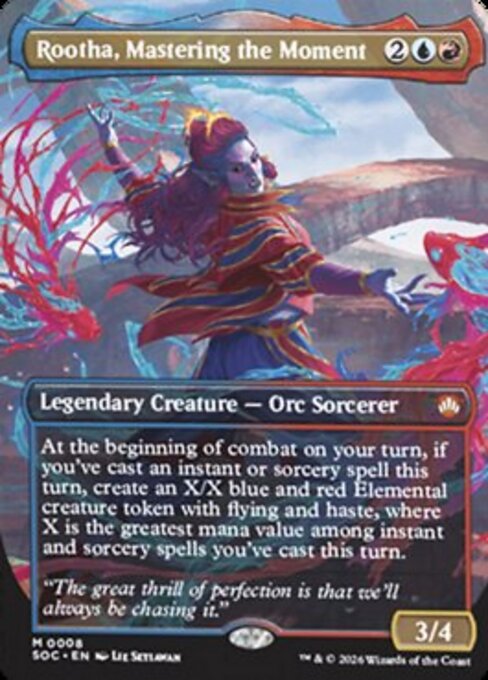
Rootha, Mastering the Moment measures the single largest instant or sorcery you cast each turn and hands you a flier that size — so this deck's ceiling is a spell, not a board.
Most spellslinger commanders count spells. Rootha measures one. At the beginning of combat on your turn, if you've cast an instant or sorcery that turn, you create an X/X blue and red Elemental with flying and haste, where X is the greatest mana value among the instants and sorceries you cast — the biggest one, not the sum. Three cantrips get you a 2/2. Volcanic Salvo gets you a 12/12 that attacks the moment it lands.
That one word, greatest, is what makes this deck strange to upgrade. The standard spellslinger advice is to load up on one-mana card selection, and here that advice quietly builds a deck whose commander makes 1/1s.
The box already leans the right way. Resolving all 100 cards against Scryfall: 29 of them are instants or sorceries outright, with three more creatures whose other half is one. Seven sit at mana value 8 or higher, and five of those seven carry delve or built-in cost reduction. The problems are elsewhere — a mid-curve stuffed with five-mana sorceries that do nothing for the ceiling, and seven lands that always enter tapped.
 35
35 35
35Upgraded list: 100 cards, 38 lands (15 basic), 27 creatures, average mana value 4.1. Mana sources: 35 blue, 35 red. No Game Changers and no mass land denial, so the deck sets no bracket floor. How brackets work →
What are the best Prismari Artistry upgrades?
Ranked by how much each one moves Rootha's number. Prices are Scryfall market at the time of writing; hover any card name for the current price.
- Temporal Trespass (~$3.34) — mana value 11, and delve routinely drops it to {U}{U}{U}. An 11/11 flier with haste plus an extra turn, off three blue mana, is the biggest single swing available to this commander.
- Mizzix's Mastery (~$9.59) — four mana to exile Volcanic Salvo from your graveyard and cast the copy for free. The copy keeps the original's mana value, so Rootha sees a 12.
- Chandra's Ignition (~$8.22) — the deck makes one enormous creature per turn and ships no way to convert it into a win. This deals the Elemental's power to each other creature and to each opponent, so the Elemental survives its own sweeper.
- Past in Flames (~$3.99) — every instant and sorcery in your graveyard gains flashback for the turn. In a deck whose graveyard fills up with mana value 8 and above, that's a second Volcanic Salvo more often than it's a second cantrip.
- Sublime Epiphany (~$0.32) — thirty-two cents for a mana value 6 instant that can copy a creature you control. Cast it in your combat step after Rootha's trigger resolves and the copy is a second huge Elemental.
The full list runs fourteen in and fourteen out, and most of the gain comes from what leaves.
Rootha counts one spell, so the five-drops are the problem
Break the box's 29 instants and sorceries out by mana value and the problem separates itself from the ceiling. Seven cost exactly two. Six cost exactly five. Seven sit at mana value 8 or higher.
The five-mana band is where this deck leaks. Those spells cost a whole turn and hand Rootha a 5/5, when the same turn spent on a discounted Dig Through Time hands her an 8/8. Counting every card type, the box runs eleven five-drops. The upgraded list runs six.
Two things follow. Cheap spells never shrink the Elemental — X is a maximum, so a two-mana cantrip cast alongside Dig Through Time still leaves you with an 8/8. The real cost of a cantrip here is the slot it takes from a spell that could have raised the number.
The second is timing. Sorceries outnumber instants 19 to 10 in the box, which means two turns in three you're tapping out in your precombat main phase just to switch the commander on. Every instant you add buys a turn where you can hold up an answer and still get your token. Three of my fourteen adds are instants or have flash, and the upgraded list runs 12 instants against 15 sorceries.
Six spells that cost far less than they say
Rootha reads mana value, and mana value is printed on the card no matter what you actually paid. That gap is the engine. Six cards in the upgraded list live inside it:
- Volcanic Salvo — mana value 12, costs {X} less where X is the total power of creatures you control.
- Temporal Trespass — mana value 11, delve.
- Furygale Flocking — mana value 10, costs {1} less for each instant and sorcery card in your graveyard.
- Blasphemous Act — mana value 9, costs {1} less for each creature on the battlefield.
- Dig Through Time and Treasure Cruise — mana value 8 apiece, delve.
Volcanic Salvo is the one worth staring at. Its discount scales with the total power of your creatures, and Rootha's entire job is making the biggest creature at the table. Last turn's 8/8 makes this turn's Volcanic Salvo cost eight less, and casting it makes a 12/12. The loop is real even when it only runs once.
Cost reducers stack onto this in a way that's easy to undervalue, because they shrink what you pay without touching what Rootha reads. The box ships three creatures that cut instant and sorcery costs by {1}; Goblin Electromancer makes four. With two of them out, Dig Through Time is a two-mana 8/8 before you exile a single card.
What comes out, and why
Fourteen cards, in three groups. The count fell out of the deck rather than a target — there's a defensible case against more than twenty cards here, and these are the fourteen I'd actually argue for.
Symmetrical effects that undo your own board
Aether Gale returns six nonland permanents to hand. Your Elementals are tokens, so bouncing one removes it from the game permanently, and tokens are Rootha's entire output. Five mana to hand your opponents their commanders back and delete your own board is the worst card in the box for this deck specifically.
Chain Reaction deals damage equal to the number of creatures on the battlefield, to every creature. That kills Rootha, and a Rootha in the command zone makes nothing. Blasphemous Act already does this job with a bigger number and a real discount attached, so keeping both means two cards that turn your own commander off.
Mirrorwing Dragon hands its ability to the table. If an opponent targets it with a removal spell, they copy that spell for each of their creatures too. It's a five-mana body whose text works for everyone.
Five-mana sorceries the ceiling doesn't need
Abstract Performance costs six and lets an opponent choose which half you keep. Replication Technique costs five and its demonstrate clause hands an opponent the same effect. Dance with Calamity has a mana value of 8, which is exactly what this deck wants, and a real cost of eight mana, which is not. Rousing Refrain is a ritual whose output depends on an opponent's hand size; Mana Geyser is the one to keep. Volcanic Torrent and Throes of Chaos both cascade into the cheap half of the deck, and the cheap half is the half I'm shrinking.
Rionya, Fire Dancer deserves its own line, because the reason it goes is a timing rule rather than a cost. Rionya triggers at the beginning of combat, same as Rootha. All of your beginning-of-combat triggers go on the stack together, and targets are locked in as they go on the stack, before any of them resolve. Rootha's Elemental doesn't exist yet when Rionya picks its target. The one creature you most want to copy is the one creature Rionya can never see.
Lands, and the shroud problem
Path of Ancestry enters tapped and scries when you spend its mana on a creature that shares a type with your commander. Rootha is an Orc Sorcerer. Outside the commander itself the deck has three Orcs and no other Sorcerer, so that scry fires on 3 of the other 25 creatures.
Temple of the False God produces nothing whatsoever until you control five lands, in a deck already one source short on double red. Molten Tributary is a tapland with no text beyond entering tapped, which makes it the cleanest of the seven to remove.
Lightning Greaves is the swap I expect the most argument about. Shroud means nobody can target the equipped creature, you included. This deck runs Twinflame, Rite of Replication and Maestro's Gift, all of which target a creature you control, Muddle, the Ever-Changing wants a target as well, and I'm adding Sublime Epiphany. Swiftfoot Boots grants hexproof, which stops opponents and leaves your own copy effects working. You pay {1} to equip instead of {0}, and you get to keep playing your own deck.
The cards that look like cuts and aren't
Judged on cost alone, twenty-one cards in the upgraded list read as cuttable, and that judgement gets this deck exactly backwards. Fourteen of the twenty-one cost five or more, which is the payoff here rather than the problem. Five are lands that enter tapped and stay because I'm not going below 38. The last two are Swiftfoot Boots and Inspired Skypainter, both of which point at a single creature in a deck full of tokens.
The three most likely to get cut by mistake are the three biggest. Volcanic Salvo costs twelve and is the best card in the deck. Blasphemous Act costs nine and is usually one red mana. Dig Through Time costs eight and is usually two blue.
Brudiclad, Telchor Engineer costs six and looks like an overpriced lord. It triggers at the beginning of combat, and unlike Rionya it makes its choice on resolution rather than on announcement. Order Rootha's trigger to resolve first and Brudiclad can choose the Elemental that just arrived, at which point every other token you control, Treasures included, becomes a copy of it. With a 9/9 on the board that's the game.
Surge to Victory costs six and reads like an expensive combat trick until you notice it exiles an instant or sorcery from your graveyard and pumps your whole team by that card's mana value. With Volcanic Salvo in the yard that's +12/+0.
Plargg and Nassari, Creative Technique and Mana Geyser all sit at five and all stay. The first two cast spells for free, which counts as casting and therefore feeds Rootha's number. The third is the ritual that lets you cast an eight-drop on turn six.
Swiftfoot Boots is a single-creature attachment in a deck full of tokens, which is true and beside the point. It's there for one creature, and that creature is the commander the deck cannot function without.
Copies aren't casts, and this deck knows it
Rootha's ability counts instants and sorceries you have cast. A copy made by a copy effect isn't cast and won't raise X. A copy you're told you may cast without paying its mana cost is cast, and will.
That distinction explains something in the decklist that looks like coincidence. The box ships nine cards that let you cast a spell without paying for it — Creative Technique, Plargg and Nassari, Surge to Victory, Renegade Bull, Dance with Calamity, Rousing Refrain, Abstract Performance, Throes of Chaos and Volcanic Torrent — against comparatively few plain copy effects. The free-cast half feeds the commander.
Worth knowing at the table: Rootha, Mercurial Artist, the three-mana legend sharing the commander's name, copies a spell rather than casting it. The copy still resolves and still does its job. It just won't make the Elemental any bigger.
Three of my adds land on the right side of that line. Mizzix's Mastery, Etali, Primal Storm and Sunbird's Invocation all say cast, and all say without paying.
Your combat step has an order, and it matters
Once Rootha is out, several triggers fire at the beginning of combat at once and you choose how they stack. Two of them can copy the Elemental, one can't, and the difference is whether the ability targets.
- Determined Iteration populates. Populate picks a creature token on resolution and doesn't target, so resolve Rootha's trigger first and the populate can copy the fresh Elemental — with haste, for two mana.
- Brudiclad, Telchor Engineer chooses on resolution too. Same ordering, and every other token you control becomes a copy of the big one.
- Rionya, Fire Dancer targets on announcement, which is why it's in the cuts above.
One more that isn't a beginning-of-combat trigger at all: Redoubled Stormsinger copies each creature token you control that entered this turn, when it attacks. The Elemental entered this turn. Attack with both and it comes along tapped and attacking, for free.
The mana base
Thirty-eight lands is right for a deck with an average mana value of 4.08, so I left the count alone. The problem is what those lands do on arrival: seven of the 38 enter tapped no matter what, on top of five more that enter tapped conditionally.
Cutting Path of Ancestry, Temple of the False God and Molten Tributary for Riverglide Pathway, Fiery Islet and Spirebluff Canal takes the always-tapped count from seven to five. Riverglide Pathway and Fiery Islet enter untapped unconditionally. Spirebluff Canal enters untapped while you control two or fewer other lands, which is turns one through three — where a deck hoping to cast a discounted eight-drop feels tempo most.
The colour maths improves alongside it. Run the shipped list through the same hypergeometrics as the Deck Mana Audit and the box has 34 blue sources against the 36 wanted for double blue on turn three — two short, at 88.2%. Trading three colourless-leaning lands for three duals takes blue to 35 sources and 89.5%. Red sits at 35 sources in both lists, one short of the same target.
Neither gap is worth panicking over. Only nine spells in the upgraded list want double blue and eleven want double red, and the cheapest of them costs two, so the turn-three benchmark is stricter than what the deck actually asks for. If you want to close them anyway, the answer is Steam Vents and more untapped duals, not more basics.
What the fourteen swaps changed
Every number here describes the upgraded list, not the box.
- Lands that always enter tapped: 7 → 5.
- Blue sources: 34 → 35, moving double blue on turn three from two short to one.
- Five-drops: 11 → 6. Six-drops: 3 → 6. Average mana value barely moves, 4.08 → 4.10, because this trades a fat mid-curve for a taller top end rather than making the deck cheaper.
- Spells at mana value 8 or more: 7 in both lists, but six of the seven now carry delve or built-in cost reduction, against five before.
- Instants: 10 → 12, against 19 → 15 sorceries.
- Instant and sorcery cost reducers: 3 → 4.
- Card draw: 10 → 11. Spot removal: 5 → 6. Ramp: 9 → 8.
- No Game Changers and no mass land denial in either list, so the upgraded deck sets no bracket floor — exactly as the box doesn't.
The fourteen adds come to about $48 at Scryfall market as I write this, taking the deck's total from $78.81 to $117.91.
The upgraded decklist
All 100 cards after the swaps. Hover any name to see the card and its current price.
“Load into the deck builder” opens this list in your account, pinned to the printings the box shipped, ready to edit or save. “Copy decklist” gives you plain text for Moxfield, Archidekt or Arena — no account needed.
Commander 1
- Rootha, Mastering the Moment

Creatures 26
- Archmage Emeritus
- Brazen Borrower // Petty Theft
- Brudiclad, Telchor Engineer
- Curiosity Crafter
- Dirgur Focusmage // Braingeyser
- Etali, Primal Storm
- Faerie Mastermind
- Galazeth Prismari
- Goblin Electromancer
- Goldspan Dragon
- Harmonic Prodigy
- Inspired Skypainter // Maestro's Gift
- Leitmotif Composer
- Manaform Hellkite
- Muddle, the Ever-Changing
- Plargg and Nassari
- Prismari Pianist
- Redoubled Stormsinger
- Renegade Bull
- Rootha, Mercurial Artist
- Solemn Simulacrum
- Storm-Kiln Artist
- Stormcatch Mentor
- Thunderclap Drake
- Torrential Gearhulk
- Veyran, Voice of Duality




Instants 12
- Abrade
- Arcane Denial
- Big Score
- Chaos Warp
- Dig Through Time
- Frantic Search
- Magma Opus
- Prismari Charm
- Prismari Command
- Reality Shift
- Resculpt
- Sublime Epiphany

Sorceries 15
- Blasphemous Act
- Chandra's Ignition
- Creative Technique
- Deep Analysis
- Expressive Iteration
- Furygale Flocking
- Mana Geyser
- Mizzix's Mastery
- Past in Flames
- Rite of Replication
- Surge to Victory
- Temporal Trespass
- Treasure Cruise
- Twinflame
- Volcanic Salvo



Artifacts 6
- Arcane Signet
- Cursed Mirror
- Fellwar Stone
- Sol Ring
- Swiftfoot Boots
- Talisman of Creativity
Enchantments 2
- Determined Iteration
- Sunbird's Invocation

Lands 38
- Cascade Bluffs
- Coastal Peak
- Command Tower
- Exotic Orchard
- Fabled Passage
- Ferrous Lake
- Fiery Islet
- Frostboil Snarl
- Hall of Oracles
- 8× Island
- 7× Mountain
- Mystic Sanctuary
- Prismari Campus
- Reliquary Tower
- Restless Spire
- Riverglide Pathway // Lavaglide Pathway
- Scorched Geyser
- Shivan Reef
- Spectacle Summit
- Spirebluff Canal
- Study Hall
- Sulfur Falls
- Temple of Epiphany
- Terramorphic Expanse
- Turbulent Springs
FAQ
Why does Rootha's Elemental change size so much between turns?
Because X is the greatest mana value among the instants and sorceries you cast that turn, not a count of them and not a total. Cast only Expressive Iteration and you get a 2/2. Cast Furygale Flocking and you get a 10/10 with flying and haste. Half the box's instants and sorceries cost five or more, so an average turn lands in the middle and the big ones are what you are digging toward.
Do copy effects make the Elemental bigger?
Only the ones that tell you to cast the copy. Rootha counts spells you have cast, so Mizzix's Mastery and Creative Technique both raise X, while Rootha, Mercurial Artist copies a spell without casting it and leaves X where it was. The copy still resolves normally either way.
Can Rionya, Fire Dancer copy the Elemental Rootha just made?
No. Both abilities trigger at the beginning of combat and go on the stack together, and Rionya's targets are chosen at that moment — before Rootha's trigger has resolved and made the token. Determined Iteration and Brudiclad, Telchor Engineer both choose on resolution instead, so they can copy it if you order Rootha's trigger to resolve first.
Is shroud actually a problem in this deck?
Yes, which is why Lightning Greaves comes out for Swiftfoot Boots. Shroud stops you targeting your own commander, and this deck wants to target creatures it controls with Twinflame, Rite of Replication, Maestro's Gift and Sublime Epiphany. Hexproof only stops your opponents.
How often will I actually cast Temporal Trespass?
More often than eleven mana suggests. Delve exiles cards from your graveyard to pay for generic mana, and this deck fills a graveyard quickly through Frantic Search, Expressive Iteration and Big Score. Three blue mana plus eight exiled cards is the usual price, and it competes with Dig Through Time and Treasure Cruise for that graveyard, so don't plan on casting two in a turn.
What happens to Rootha when I cast Blasphemous Act?
Rootha dies. Thirteen damage kills everything on the board including your own commander, so the Elemental you get at combat that turn arrives after the wipe and survives, but the engine goes back to the command zone. That's a fair trade when you're behind and a real cost when you're not, and it's why Chandra's Ignition earns a slot — it hits each other creature and each opponent, leaving your biggest creature standing.
If I only buy one card for this deck, which one?
Temporal Trespass, at roughly $3.34. It's the highest mana value the deck can realistically cast, so it sets the size of your best token, and the extra turn means you untap and attack with it. Sublime Epiphany at about thirty cents is the best value pick if budget is the constraint.
Are 27 instants and sorceries enough to trigger Rootha every turn?
The upgraded list runs 27 outright, three more creatures whose other half is a spell, four creatures that cut spell costs by {1} and eleven cards of draw, so finding one per turn is rarely the issue. Casting the right one is. A turn where your only spell is a two-drop still triggers Rootha and still makes a 2/2, so the question is whether you'd rather hold that cantrip and cast a discounted eight-drop next turn instead.