Revival Trance (FINAL FANTASY VI) precon upgrade guide
The box can fill Terra, Herald of Hope's graveyard from the first combat — but the only cards it ever chooses to put there are the ones it happened to draw.
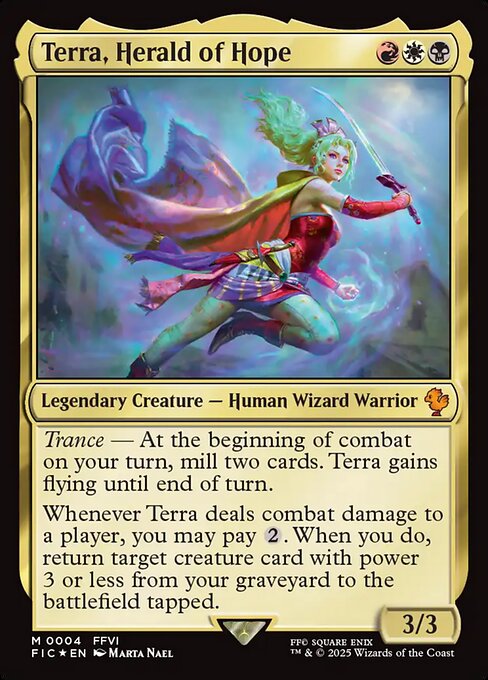
Terra mills two cards at the start of every combat and, when she connects, buys back any creature with power 3 or less for two mana. That buyback reaches 22 of the box's 35 creatures, so the engine ships nearly complete. What doesn't ship is selection: every card that reaches your graveyard from the library gets there at random, and the deck's best payoffs — Flayer of the Hatebound turning each return into damage, Anger giving the whole board haste from the bin — only work once they're actually down there. The swaps below buy the deck the ability to put a specific card in its own graveyard, then trim a top end it was never going to cast.
Everything on this page is computed from the shipped decklist, resolved card by card — the same hypergeometrics the mana base calculator runs. A number that describes the box rather than the upgraded list is marked “stock”.
 26
26 26
26 26
26Upgraded list: 100 cards, 37 lands (10 basic), 32 creatures, average mana value 3.27. Mana sources: 26 white, 26 black, 26 red. No Game Changers and no mass land denial, so the deck sets no bracket floor. How brackets work →
What are the best Revival Trance upgrades?
If the budget is five cards, these five, in order:
- Buried Alive — three creature cards of your choice straight into the graveyard for three mana. Nothing in the box can put a named card there; this is the single biggest hole in the shipped list.
- Animate Dead — two mana to return anything from any graveyard. The priciest add on this page at $7.73, and still the best rate in the deck.
- Cruel Celebrant — this deck kills its own creatures over and over; now every one of those deaths drains the table.
- Ravenous Chupacabra — with Terra's buyback it becomes a kill spell that costs two mana every combat.
- Unmarked Grave — the second copy of the Buried Alive effect: one nonlegendary card, one less mana.
The full swap list, and what comes out for it, is further down.
What the box is actually doing
Every figure here comes from the stock decklist:
- 36 creatures, 19 of them legendary — and 22 of the 35 in the ninety-nine sit at power 3 or less, inside Terra's buyback. The engine's targets ship with the box.
- Four cards pay you for the graveyard traffic itself: Celes counters your whole board when a creature arrives from the bin, Flayer of the Hatebound turns each arrival into damage, Gau hits every opponent on any turn a card leaves your graveyard, and Cyan grows one counter at a time.
- Eight more cards work from the graveyard on their own — Banon and Edgar cast things out of it, Sabin blitzes himself back, Anger hastes the team from the bin, Interceptor and The Falcon return themselves, and Snort and Laughing Mad carry flashback.
- 37 lands, stock: 25 always untapped, 7 conditional, 5 that enter tapped no matter what.
- Average mana value 3.74 stock, with 17 cards at five mana or more — a heavy top end for a deck whose commander costs three.
- 14 draw cards (high for a precon), 10 ramp, 6 spot removal, 2 wipes.
- Bracket 1 floor — zero Game Changers, no mass land denial, no extra turns, no tutors. The box runs about $58 at Scryfall market.
Read that list again and the diagnosis writes itself. The payoffs are here, the targets are here, the card flow is here. What's missing is any way to decide which card is in the graveyard — sixteen cards in the upgraded ninety-nine can put cards there on purpose, but in the stock list every one of them mills at random or discards from whatever you drew. Flayer of the Hatebound in your library is a six-drop; Flayer of the Hatebound in your graveyard is an engine. The box has no way to make that happen on demand.
How the buyback actually plays
Terra's two triggers are sequenced better than they first look. Trance mills at the beginning of combat; the buyback fires on combat damage. So a creature milled this combat can be paid for and returned this same combat — the engine has no waiting period. The flying she gains from Trance is the other half of the design: a 3/3 flier connects far more reliably than a 3/3 on the ground, and the whole deck is priced around her connecting.
Everything comes back tapped, which means combat stats are irrelevant and enter-the-battlefield text is the entire product. The bodies worth two mana, roughly in order: Palace Jailer re-takes the monarch and exiles another blocker every time it returns. Ravenous Chupacabra kills the best creature an opponent has left. Solemn Simulacrum puts a land onto the battlefield. Stitcher's Supplier mills three, restocking the shelf you're buying from. General Leo Cristophe is the deep cut — he returns another creature with mana value 3 or less when he enters, so one buyback becomes two bodies. And Setzer builds a new Blackjack every trip.
One payment can cascade four ways. A buyback is simultaneously a creature entering from your graveyard and a card leaving it — so Celes counters your team, Flayer of the Hatebound deals damage, Cyan grows, and at end of turn Gau hits all three opponents. Two mana, four triggers, every combat.
What I'd cut
Seven mana, cast honestly
Meteor Golem, Sepulchral Primordial and Angel of the Ruins all cost seven, and the stock deck can only skip that bill for a copy it happens to draw and discard — from the library, reanimation targets arrive at random. Meteor Golem is the interesting case: at power 3 it's technically a Terra buyback, and if the Golem is your kind of card, that loop is real. But you still have to pay seven the first time, and Ravenous Chupacabra joins the deck doing the same job from four mana with no setup.
Sepulchral Primordial has a deck-specific problem on top of the generic one: it robs opposing graveyards, and this deck actively empties them. Kefka exiles a card from each opponent's graveyard every end step, Espers to Magicite exiles all three yards at once, and Summon: Esper Valigarmanda's first chapter takes a spell from every graveyard on the table. Seven mana for a 5/4 whose payoff your own maindeck works against.
Angel of the Ruins is the closest call on this page — plainscycling for two makes it the one seven-drop that's never dead. But a 5/7 that exiled two artifacts is the fair-value option in a slot the deck wants for its engine, and its double white is part of a turn-four white check that's already eight sources short in the stock list.
Cards that hand the choice to your opponents
Rejoin the Fight spends six mana to return three creatures — chosen by your opponents, one each. In a list where half the creatures are one- and two-power utility bodies, the table will hand you the three cheapest things in your bin and keep Kefka down there. Ruin Grinder's death trigger has the same clause: each player may discard and draw seven, so opponents refill exactly when it helps them and decline when it doesn't.
A five-drop pointing the wrong way
Archfiend of Depravity asks for double black in the deck's shortest colour, sits at power 5 where the buyback can't reach it, and plays defence — it thins opposing boards so you don't get attacked. Terra's whole design needs her attacking. The deck wants its five-mana turns building the engine, not fortifying.
The flavour cuts
Umaro and Gogo are the only character cards leaving, and I'd understand keeping both. The trouble with Umaro is the word “random”: the mode you want — discard your hand, draw four — shows up a third of the time, and you can't build around a trigger you can't pick. Gogo copies your best creature but forces both copies to attack, which is a fine way to lose the original. If the cast is why you bought this box, put them back in over Ravenous Chupacabra and Faithless Looting and accept a slightly slower list.
Three lands
Geothermal Bog, Sacred Peaks and Sunlit Marsh enter tapped unconditionally and offer nothing for it — no scry, no cycling, no third colour. The one honest cost of cutting them is that they carry basic land types the deck's check lands look for; the ten basics carry that weight. Nomad Outpost stays because it taps for all three colours, and Path of Ancestry stays for reasons the FAQ covers.
What I'd add
Choosing the graveyard
Buried Alive is the whole thesis in one card: for three mana, Flayer of the Hatebound and Anger go to the graveyard on purpose, and the third slot flexes — Sun Titan when you have a big reanimation spell in hand, a value body when you just want buyback options. Unmarked Grave does a smaller version of the same job for two, and Faithless Looting is the cheapest way to ditch what you drew and dig at the same time; all three of its graveyard trips (the discard, the flashback, the leaving) feed Gau.
Reanimation at the right rate
The box's big-spell suite — Reanimate, Stitch Together, Phoenix Down, Priest of Fell Rites — is genuinely good, and Animate Dead slots straight into it: two mana, any creature, any graveyard. Victimize is the sneaky one here. It returns both creatures tapped, which in most decks is the discount clause — in this deck the commander already returns everything tapped, so the clause costs nothing you weren't already paying. Sacrifice a spent buyback body, return two real threats, and if Flayer of the Hatebound is one of them, both arrivals deal damage.
Bodies worth buying back
Ravenous Chupacabra is the best two mana Terra can spend once it's in the bin. Corpse Knight drains an opponent… actually each opponent, every time another creature enters under your control — cast, reanimated, or token, it doesn't care. Cruel Celebrant is its mirror on the way out, and this deck's creatures die constantly and on purpose: Victimize wants a sacrifice, High Market is already in the box, and every buyback body that chump-blocks comes back later anyway. Between the Knight, the Celebrant and Gau, the engine stops being board development and starts being a clock.
If you outgrow this list, four cards are next, and two of them cost real money — named here with prices so the ranking stays honest. Viscera Seer and Karmic Guide are under a dollar: a sacrifice outlet the buyback can retrieve, and a power-2 flier that reanimates something on the way in. Skullclamp ($5.83) turns every death in a deck full of small bodies that die on purpose into two cards. And Altar of Dementia ($17.37) is the strongest sacrifice outlet this deck can own — every activation mills you, which restocks the shelf Terra buys from — with the honest caveat that unlike the Seer it isn't a creature, so she can never buy it back.
Three lands that are untapped when it matters
All three additions tap for white and black because those are the two short colours — the stock mana base runs 28 red sources against 25 each of white and black, with red the least demanding colour of the three. Caves of Koilos is always untapped for a life here and there. Concealed Courtyard enters untapped on turns one through three, exactly the turns a fastland needs to work; Shattered Sanctum is its complement, untapped from turn three on. The pair covers the whole game between them.
The cards that look like cuts and aren't
A six-drop with no evasion, a nine-mana sorcery, a two-mana equipment that helps one creature — several keeps here have the exact shape of a cut, and each one earns its slot for a reason the shape doesn't show.
Sun Titan looks like another uncastable six-drop. It isn't: the upgraded list holds 18 nonland permanents at mana value two or less for it to rebuy — Stitcher's Supplier, Priest of Fell Rites, Phoenix Down, the mana rocks — plus Evolving Wilds, Ash Barrens and Demolition Field from the land pile. Its best trick is returning Animate Dead, which immediately reanimates something else. It's also a fine thing to hit with Animate Dead in the first place.
Rise of the Dark Realms costs nine, and nine mana is real. But Trance alone has put ten or more cards in your graveyard by the time you can cast it, and the spell reads your own bin first — it still ends games after your Kefka has spent five turns eating everyone else's.
Flayer of the Hatebound is the card the whole upgrade package points at. Undying means even a board wipe only rents it to the graveyard, and once it's out, every reanimated creature — the buyback included — deals its power in damage on arrival.
Combustible Gearhulk is a punisher card, and punisher cards are usually bad because the opponent picks the half that hurts you less. Here both halves pay you: three cards in hand, or three cards in the graveyard plus damage. When the “punishment” is fuel, the choice stops mattering.
Solemn Simulacrum is the only ramp in the deck that Terra can buy back. A land every combat, for two mana, forever.
Tragic Arrogance is one of exactly two wipes in a deck whose healthy range is two to four — and it's the wipe where you choose every survivor, so Terra always lives through her own reset.
Swiftfoot Boots helps exactly one creature in a 32-creature deck, but this deck is secretly a one-creature deck: everything is priced around Terra attacking every turn and surviving it. Hexproof and haste on the engine is not a luxury.
Anger deserves its own warning label. It hastes your whole board from the graveyard — precisely where this deck puts cards — making it the one creature you should never pay two mana to return. One caveat the land cuts create: Anger needs you to control a Mountain, and the upgraded list is down to four (three basics and Smoldering Marsh). It'll be on more often than not, but it's no longer automatic.
Can it cast what it keeps?
Single pips are clean in all three colours — 91–94% on curve in the stock list, slightly better after the swaps. The pressure is all in the doubles.
Black is the tight one on paper: eight stock spells want two black pips, and measuring from the cheapest of them (Stitch Together, at two mana) the stock base covers a turn-three double black just 71.8% of the time. In practice Stitch Together is a threshold card you hold until the graveyard hits seven, so the honest constraint is Bedevil and Interceptor in the midgame. The swaps push black from 25 to 26 sources and remove two of the eight demanding spells; the same check comes up 74.2%.
White's double is Palace Jailer on turn four — 77.7% stock, 79.8% after the swaps. And towering over everything is Ruinous Ultimatum's seven coloured pips; every land this page adds pays for two of them. The one number that moves the wrong way: the cut duals were red sources, so the turn-six double red for Combustible Gearhulk and Ruinous Ultimatum slips from 90.9% to 88%. Two spells, late turns, two points — I'll take that trade for a mana base with three fewer dead turns.
After the swaps the deck runs the same 37 lands with 2 unconditionally tapped instead of 5, and the curve drops from 3.74 average mana value to 3.27, with the count of five-plus-mana cards down from 17 to 10. The list runs about $76 at Scryfall market, roughly $22 of it the additions.
The upgraded decklist
The full hundred after the swaps — hover any name to see the card and its current price.
“Load into the deck builder” opens this list in your account, pinned to the printings the box shipped, ready to edit or save. “Copy decklist” gives you plain text for Moxfield, Archidekt or Arena — no account needed.
Commander 1
- Terra, Herald of Hope
Creatures 31
- Anger
- Banon, the Returners' Leader
- Celes, Rune Knight
- Combustible Gearhulk
- Corpse Knight
- Cruel Celebrant
- Cyan, Vengeful Samurai
- Edgar, Master Machinist
- Flayer of the Hatebound
- Gau, Feral Youth
- General Leo Cristophe
- Interceptor, Shadow's Hound
- Kefka, Dancing Mad
- Locke, Treasure Hunter
- Millikin
- Mog, Moogle Warrior
- Morbid Opportunist
- Palace Jailer
- Pitiless Plunderer
- Priest of Fell Rites
- Ravenous Chupacabra
- Sabin, Master Monk
- Setzer, Wandering Gambler
- Shadow, Mysterious Assassin
- Siegfried, Famed Swordsman
- Solemn Simulacrum
- Stitcher's Supplier
- Strago and Relm
- Summon: Esper Valigarmanda
- Sun Titan
- The Warring Triad






Instants 6
- Bedevil
- Big Score
- Crackling Doom
- Espers to Magicite
- Laughing Mad
- Mortify
Sorceries 12
- Buried Alive
- Faithless Looting
- Legions to Ashes
- Night's Whisper
- Reanimate
- Rise of the Dark Realms
- Ruinous Ultimatum
- Snort
- Stitch Together
- Tragic Arrogance
- Unmarked Grave
- Victimize

Artifacts 12
- Arcane Signet
- Coin of Fate
- Commander's Sphere
- Key to the City
- Mind Stone
- Phoenix Down
- Sol Ring
- Swiftfoot Boots
- Talisman of Conviction
- Talisman of Indulgence
- The Falcon, Airship Restored
- Wayfarer's Bauble
Enchantments 1
- Animate Dead
Lands 37
- Ash Barrens
- Battlefield Forge
- Caves of Koilos
- Clifftop Retreat
- Command Tower
- Concealed Courtyard
- Demolition Field
- Desolate Mire
- Dragonskull Summit
- Evolving Wilds
- Exotic Orchard
- Fetid Heath
- Foreboding Ruins
- Furycalm Snarl
- Graven Cairns
- High Market
- Isolated Chapel
- 3× Mountain
- Nomad Outpost
- Path of Ancestry
- 4× Plains
- Rogue's Passage
- Rugged Prairie
- Shadowblood Ridge
- Shattered Sanctum
- Shineshadow Snarl
- Smoldering Marsh
- Sulfurous Springs
- Sunscorched Divide
- 3× Swamp
FAQ
Which creatures can Terra, Herald of Hope bring back?
Any creature card with power 3 or less in your graveyard, returned tapped, for two generic mana whenever she deals combat damage to a player. In the upgraded list that's 23 of the 31 creatures in the ninety-nine. Because they come back tapped, enter-the-battlefield text is what you're paying for — Palace Jailer re-takes the monarch, Ravenous Chupacabra kills something, Solemn Simulacrum fetches a land, Stitcher's Supplier mills three more.
Why cut Sepulchral Primordial from a graveyard deck?
Because this deck empties the graveyards it would rob. Kefka, Dancing Mad exiles a card from each opponent's graveyard every end step, Espers to Magicite exiles all three at once, and Summon: Esper Valigarmanda's first chapter takes an instant or sorcery from every graveyard. Seven mana for a 5/4 whose payoff your own deck works against.
Can Terra's Trance mill me out of the game?
No realistic game gets there. Trance puts two cards in your graveyard per combat, so ten combats is twenty cards out of a ninety-nine-card library. The thresholds the deck cares about run the other way — Stitch Together wants seven cards in the graveyard and The Warring Triad wants eight, and Trance plus the deck's own discard gets there around turn five or six.
Why keep Path of Ancestry when three other tapped lands got cut?
Geothermal Bog, Sacred Peaks and Sunlit Marsh enter tapped and do nothing else. Path of Ancestry enters tapped and then scries on 19 of the 31 creatures in the upgraded ninety-nine, plus every cast of Terra herself. One tapped turn buys a scry most creature turns; the other three bought nothing.
What do the recommended cards cost on top of the box?
About $22 at Scryfall market prices when this guide's numbers were computed. Animate Dead is a third of that bill at $7.73; eight of the eleven cards are under two dollars.
Which FINAL FANTASY VI characters leave the deck?
Umaro and Gogo are the only character cards cut — fourteen party members and villains stay, along with Interceptor, The Falcon and The Warring Triad. If the characters are why you bought the box, put Umaro and Gogo back in over Ravenous Chupacabra and Faithless Looting; the list gets a little slower and stays coherent.
Do Reanimate and Animate Dead push the deck up a bracket?
No. Reanimate ships in the box, Animate Dead isn't on the Game Changers list, and neither the stock list nor the upgraded one runs a single Game Changer — the bracket checker gives both a Bracket 1 floor. Reanimating fairly costed creatures is a speed upgrade, not a bracket change.