World Shaper precon upgrade guide
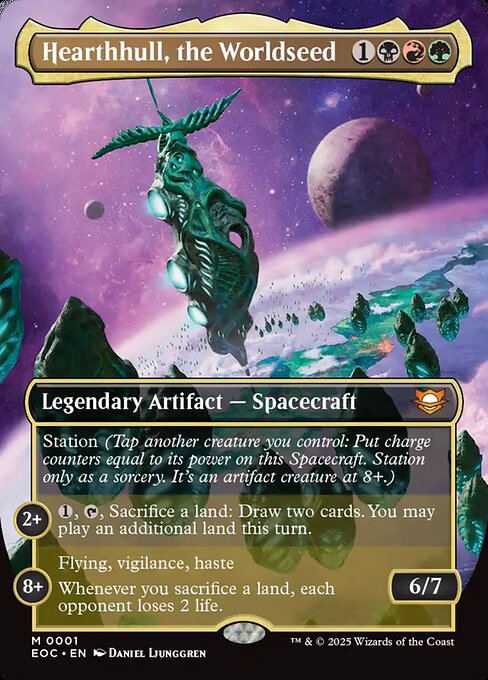
Hearthhull, the Worldseed drains every opponent for two life per sacrificed land from the moment it resolves, and the box ships ten lands that sacrifice themselves — what it doesn't ship is World Shaper, the card that shares the deck's name.
Read the commander twice, because the best line is easy to file in the wrong place. The drain isn't a station tier: “whenever you sacrifice a land, each opponent loses 2 life” sits below the tiers as ordinary always-on text, live the turn Hearthhull comes down. Stationing to 2+ buys the draw engine — {1}, tap, sacrifice a land: draw two cards and keep an extra land drop — and 8+ merely turns the ship into an attacker. You never need to get there.
Work through the shipped list one card at a time and the engine turns out to be denser than the box art suggests. Ten of the 42 lands sacrifice themselves: Fabled Passage, Evolving Wilds, Terramorphic Expanse and Escape Tunnel; the enter-and-fetch trio of Cabaretti Courtyard, Maestros Theater and Riveteers Overlook; Myriad Landscape, Mountain Valley and Rocky Tar Pit. With the commander out, each of those deaths takes six life off a four-player table before a single payoff triggers — and the payoffs are real: a 5/3 from Titania, Protector of Argoth, a 4/4 from Baloth Prime, tokens from Scouring Swarm, plus Korvold, Fae-Cursed King, Mazirek, Kraul Death Priest and Mayhem Devil converting any sacrifice at all.
What holds the box back sits on the other side of the ledger. Exactly one card — Szarel, Genesis Shepherd — can replay lands out of the graveyard. Four spells want {R}{R} against twelve red sources, a 29.9% proposition on curve. And six cards cost six or more in a list whose conventional ramp count is five. The ten swaps below attack those three numbers and nothing else.
 17
17 13
13 18
18Upgraded list: 100 cards, 42 lands (17 basic), 29 creatures, average mana value 3.33. Mana sources: 17 black, 13 red, 18 green. No Game Changers and no mass land denial, so the deck sets no bracket floor. How brackets work →
What are the best World Shaper upgrades?
Ranked by how much deck you get per dollar. Every one is argued in the sections below, and the ten cuts that make room are further down the page.
- World Shaper ($9.84, the most expensive card on this page) — when it dies, every land card in your graveyard returns to the battlefield tapped. The deck spends lands like a currency; this hands the whole purse back.
- Ramunap Excavator ($5.76) — play lands from your graveyard, every turn. The box owns this effect exactly once, on a five-mana legend.
- Sylvan Safekeeper ($6.40) — a sacrifice outlet that costs nothing to use and protects the legends the table has to answer. Once Hearthhull is out, every activation is also two life off each opponent.
- Zuran Orb ($3.28) — sacrifice any number of lands, at instant speed, for zero mana. End a turn by draining the table and stocking the graveyard.
- Dragonskull Summit, Rootbound Crag and Game Trail ($1.04 for all three) — untapped duals in for the three cycling taplands. With 17 basics in the deck, their conditions almost always hold.
Ten lands that bury themselves
The count that sold me on upgrading rather than rebuilding: ten of the box's lands go to the graveyard on their own, and every one of them ramps or fixes on the way. The four fetches crack for basics, the three streets from New Capenna fetch the moment they enter, Myriad Landscape grabs two, and the two slow fetches — Mountain Valley and Rocky Tar Pit — put their land in untapped and can find the typed duals, not just basics.
Each of those ten is a Hearthhull trigger worth six life across three opponents, a land in the graveyard for the recursion to reuse, and a token if Titania, Protector of Argoth or Baloth Prime is watching. The spell-side outlets stack on top: Harrow and Roiling Regrowth ramp while triggering everything, Sprouting Goblin and Uurg, Spawn of Turg sell spare lands one at a time, Braids, Arisen Nightmare taxes the table every end step, and God-Eternal Bontu is the blowout — sacrifice five spare lands to its trigger and that's five cards drawn and ten life off each opponent in one resolution.
One quiet interaction worth knowing before the first game: with The Gitrog Monster out, every land that hits any graveyard draws you a card, so its own upkeep sacrifice pays for itself — and Dakmor Salvage turns those draws into dredges that feed the yard further.
The engine's missing half
A deck this eager to bury lands should be equally good at digging them back up, and here the box is thin. Szarel, Genesis Shepherd is the only card that plays lands from the graveyard. Exploration Broodship half-counts — once a turn it casts a permanent from the yard if you feed it a land — and Groundskeeper hands basics back to your hand at {1}{G} per trip. The mass returns, Splendid Reclamation and Aftermath Analyst, are excellent and lonely.
So the recursion gets tripled. Ramunap Excavator is Szarel's effect on a three-mana body; Conduit of Worlds is the same line on an artifact that also recasts a dead Titania in the late game; World Shaper is Splendid Reclamation on legs, and because the deck is full of sacrifice outlets, you choose the moment it dies. Wrenn and Seven feeds them all — the +1 pulls every land from the top four into hand and bins the rest, the 0 dumps those lands onto the battlefield, and the ticket price is two dollars and change.
Evolution Sage solves a different bottleneck: the station tax. Tapping engine creatures to charge the commander is real tempo, but station it once with any creature and the Sage proliferates it toward 8 on every landfall — the extra drop, a fetch resolving, or all eight lands of a Splendid Reclamation at once. The same triggers grow Korvold, Fae-Cursed King, Centaur Vinecrasher, Mazirek, Kraul Death Priest's counters and the hatchlings on Eumidian Hatchery.
Double red on twelve sources
The stock mana base pays {R}{R} on curve 29.9% of the time, and four spells ask it to: Hammer of Purphoros, Moraug, Fury of Akoum, Omnath, Locus of Rage and Planetary Annihilation. Rather than rebuild the mana base around costs the deck barely uses, the swaps remove three of the four — after them, the only double-red card left is Planetary Annihilation, wanted by turn five, where the odds are 44.1%. Still the shakiest cast in the deck, and the one worth stretching for.
The land half of the fix trades the three cycling taplands for Dragonskull Summit, Rootbound Crag and Game Trail. Seventeen basics mean the first two are on from turn two, and Game Trail's reveal gets easier every time Wrenn and Seven stuffs your hand with lands. Always-tapped lands fall from eight to five — and every survivor either buries itself or does a job, which the cuts section below gets into. Red climbs from twelve sources to thirteen. The trade isn't free: black slips from eighteen sources to seventeen, and the turn-three double-black odds ease from 51.5% to 48.1% — softened by the fact that one of the five {B}{B} spells, Eumidian Wastewaker, left the deck anyway.
What I'd cut
Ten cards. The first three answer the same charge: the box's hardest costs were paying for its loosest effects.
- Omnath, Locus of Rage — {3}{R}{R}{G}{G} is the hardest cast in the deck, seven mana lands it with nothing to show until another land arrives, and the drain plan would rather sacrifice lands than keep them around for landfall. Rampaging Baloths stays as the landfall army at a cost the mana actually pays.
- Moraug, Fury of Akoum — extra combats reward a board built to attack. This board is Uurg, Spawn of Turg and The Gitrog Monster — bodies that want to sit still and convert lands into cards.
- Hammer of Purphoros — its Golem ability does trigger the drain, but three mana plus a land per 3/3 is a slow outlet, and {R}{R} at three is exactly the cost the stock mana kept missing. Haste serves an attacking deck; this isn't one.
- World Breaker — seven mana to exile one artifact, enchantment or land, and the on-theme buyback costs three more plus a land per round. Beast Within, Putrefy and Windgrace's Judgment answer more for less.
- Eumidian Wastewaker — four mana with double black, it has to keep attacking, and the draw only pays out when the symmetric discard happens to hit lands.
- Juri, Master of the Revue — counts every sacrifice without doing anything per trigger. Korvold, Fae-Cursed King draws, Mazirek, Kraul Death Priest pumps the team, Mayhem Devil pings; Juri just gets bigger and waits to die.
- Groundskeeper — one basic at a time, back to hand, {1}{G} per trip. The adds play lands straight out of the graveyard and skip the hand entirely.
- Festering Thicket, Canyon Slough and Sheltered Thicket — the cycling taplands. Two mana to bin a land is a poor rate next to ten lands that bury themselves for free, and played as lands they cost a turn every time.
What I'd add
Ten cards, $32.58 all together at Scryfall market prices the day this page was written.
Lands out of the graveyard
- World Shaper ($9.84) — mills three per attack to stock the yard, then dies on your schedule and returns every land card in it. Feed it to God-Eternal Bontu or Braids, Arisen Nightmare and the sacrifice is itself a profit.
- Ramunap Excavator ($5.76) — the sacrificed land comes back on your next land drop, drains again, and dies again. With Hearthhull's own activation granting the extra drop, one Excavator makes every turn a two-for-nothing.
- Conduit of Worlds ($0.99) — the same text on an artifact, plus a late-game mode that recasts a fallen creature on a quiet turn.
- Wrenn and Seven ($2.92) — four cards deep for lands every turn, a 0 that plays them in bulk, and a graveyard that grows either way.
Outlets that cost nothing
- Sylvan Safekeeper ($6.40) — free activations, each one a drain trigger, and the shroud keeps Titania, Protector of Argoth, The Gitrog Monster or Szarel, Genesis Shepherd out of removal range at exactly the moment they matter.
- Zuran Orb ($3.28) — zero to cast, zero to use, any number of lands, any time. The card that turns an end step into six or ten life swung in your favor.
Charge without the crew
- Evolution Sage ($2.35) — landfall proliferate. One station of any creature, and every land that enters pushes Hearthhull toward its 8+ tier without tapping another body all game.
Red that doesn't wait
- Dragonskull Summit ($0.46), Rootbound Crag ($0.29) and Game Trail ($0.29) — the deck's thin colour gets a thirteenth source and its taplands stop costing turns.
Three cards stayed out on price alone. Crucible of Worlds ($35.34) is Ramunap Excavator's artifact twin at six times the cost. Ancient Greenwarden ($12.44) doubles every trigger this page just spent sections counting. Scapeshift ($47.65) is the ceiling: sacrifice eight lands with Hearthhull out and each opponent loses sixteen life before the search even resolves. If any of the three is already in your binder, Conduit of Worlds is the slot to take.
Six keeps that look wrong on paper
Payoff cards read as overpriced cards until you count what they return, and this deck is mostly payoffs. These six stay.
- Blasphemous Act — nine printed mana, but it costs {1} less per creature on the battlefield, and in a four-player game that routinely means two mana. It's also the deck's only full sweep in a list that counts just one wipe against a typical two to four.
- Planetary Annihilation — five mana that plays like a finisher. Every player keeps six lands and sacrifices the rest, so with Hearthhull out and eleven lands under you, your own five sacrifices take ten life off each opponent, hand Titania, Protector of Argoth five 5/3s, sweep the small creatures with six damage, and stock the graveyard for World Shaper to undo the whole thing next turn. It also happens to punish whoever ramped hardest.
- Titania, Protector of Argoth — a five-drop with no keywords, which looks like a cut right up until you count her tokens: ten self-burying lands, Zuran Orb and the commander's own activation each hand her a 5/3.
- Escape to the Wilds — five mana for five cards and an extra land drop. The cost profile matches the cards being cut; the payout doesn't.
- Mountain Valley, Rocky Tar Pit and Myriad Landscape — tapped, yes, but each buries itself to ramp or fix, which in this deck means the lost turn is repaid with six life across the table and a land in the yard to replay. A tapland that eventually pays you is a different species from one that only costs.
- Dakmor Salvage — the worst-looking land in the box until The Gitrog Monster is out, at which point every dredge that flips a land is a fresh draw, and Soul of Windgrace's discard abilities send it back to the yard to dredge again.
Where ten swaps leave the deck
Average mana value falls from 3.51 to 3.33, and the six-plus count from six cards to three — the top end that remains is Rampaging Baloths, Multani, Yavimaya's Avatar and Blasphemous Act, which rarely costs what it says. Always-tapped lands drop from eight to five, all five of them working lands. Red goes from twelve sources to thirteen while the double-red demand shrinks from four spells to one.
One raw count moves down: counted draw slips from eight pieces to seven with Eumidian Wastewaker gone. The replacement is the commander's own activation — two cards a turn from the command zone — plus Wrenn and Seven's +1, and neither shows up in that count. Creatures go from 31 to 29. Nothing entering or leaving touches the Game Changers list: zero before, zero after, so the deck still sets no floor above Bracket 1. The box runs $56.23 at Scryfall market as of this writing; the ten adds are $32.58 on top of it.
The upgraded decklist
The full hundred after the swaps. Hover any name for the card, its printing and today's prices.
“Load into the deck builder” opens this list in your account, pinned to the printings the box shipped, ready to edit or save. “Copy decklist” gives you plain text for Moxfield, Archidekt or Arena — no account needed.
Commander 1
- Hearthhull, the Worldseed

Creatures 29
- Aftermath Analyst
- Augur of Autumn
- Baloth Prime
- Braids, Arisen Nightmare
- Centaur Vinecrasher
- Evendo Brushrazer
- Evolution Sage
- God-Eternal Bontu
- Horizon Explorer
- Korvold, Fae-Cursed King
- Loamcrafter Faun
- Mayhem Devil
- Mazirek, Kraul Death Priest
- Multani, Yavimaya's Avatar
- Oracle of Mul Daya
- Rampaging Baloths
- Ramunap Excavator
- Satyr Wayfinder
- Scouring Swarm
- Soul of Windgrace
- Springbloom Druid
- Sprouting Goblin
- Sylvan Safekeeper
- Szarel, Genesis Shepherd
- The Gitrog Monster
- Tireless Tracker
- Titania, Protector of Argoth
- Uurg, Spawn of Turg
- World Shaper



Planeswalkers 1
- Wrenn and Seven
Instants 8
- Beast Within
- Harrow
- Infernal Grasp
- Putrefy
- Rakdos Charm
- Roiling Regrowth
- Tear Asunder
- Windgrace's Judgment
Sorceries 13
- Blasphemous Act
- Cultivate
- Escape to the Wilds
- Farseek
- Formless Genesis
- Gaze of Granite
- Nature's Lore
- Night's Whisper
- Pest Infestation
- Planetary Annihilation
- Skyshroud Claim
- Splendid Reclamation
- Worldsoul's Rage


Artifacts 5
- Arcane Signet
- Conduit of Worlds
- Exploration Broodship
- Sol Ring
- Zuran Orb

Enchantments 1
- Binding the Old Gods
Lands 42
- Bojuka Bog
- Cabaretti Courtyard
- Cinder Glade
- Command Tower
- Dakmor Salvage
- Dragonskull Summit
- Escape Tunnel
- Eumidian Hatchery
- Evolving Wilds
- Fabled Passage
- 8× Forest
- Game Trail
- Karplusan Forest
- Llanowar Wastes
- Maestros Theater
- 3× Mountain
- Mountain Valley
- Myriad Landscape
- Riveteers Overlook
- Rocky Tar Pit
- Rootbound Crag
- Smoldering Marsh
- Sulfurous Springs
- 5× Swamp
- Terramorphic Expanse
- Twilight Mire
- Vernal Fen
- Viridescent Bog
- Wastes
FAQ
Does Hearthhull need to be stationed before the land drain works?
No. “Whenever you sacrifice a land, each opponent loses 2 life” is ordinary always-on text, live as soon as Hearthhull, the Worldseed is on the battlefield. Stationing to 2+ unlocks the draw ability — sacrifice a land to draw two cards and gain an extra land drop — and 8+ only makes the Spacecraft a flying, vigilant attacker. You never need eight charge counters for the deck to function.
Why isn't the card World Shaper in the World Shaper precon?
The box ships without its near-namesake. World Shaper is a four-mana Merfolk that returns every land card in your graveyard to the battlefield when it dies — in a deck that buries ten of its own lands as a matter of course, that's the single most on-theme card available, and it's this guide's first add at about $10.
What are World Shaper's weaknesses out of the box?
Three show up when you resolve the shipped list: four spells want double red against only twelve red sources (about a 30% chance on curve), just one card — Szarel, Genesis Shepherd — can replay lands from the graveyard, and six cards cost six or more mana. The swaps on this page remove three of the four double-red spells and triple the graveyard recursion.
Why does the deck run 42 lands?
Because lands are the deck's ammunition, not just its mana. Hearthhull converts each one into two cards and a drain trigger, ten lands sacrifice themselves, and the recursion plays them again from the graveyard. A typical Commander deck runs 35 to 38; this one is right to overshoot, and the upgrade keeps all 42.
Doesn't cutting the cycling lands hurt the graveyard plan?
Less than it looks. Cycling does bin a land for Splendid Reclamation or Multani, Yavimaya's Avatar to find later, but it costs two mana, and played as a land the card enters tapped. The ten lands that sacrifice themselves put a land in the graveyard for free while ramping or fixing, and each one drains the table on the way through.
What Commander bracket does the upgraded list sit in?
The same floor it shipped with: zero Game Changers in the box and zero among the ten adds, so nothing forces the deck above Bracket 1. In practice it plays like a typical upgraded precon — a Bracket 2 conversation at most tables — but no single card obliges a higher label.