Blight Curse precon upgrade guide
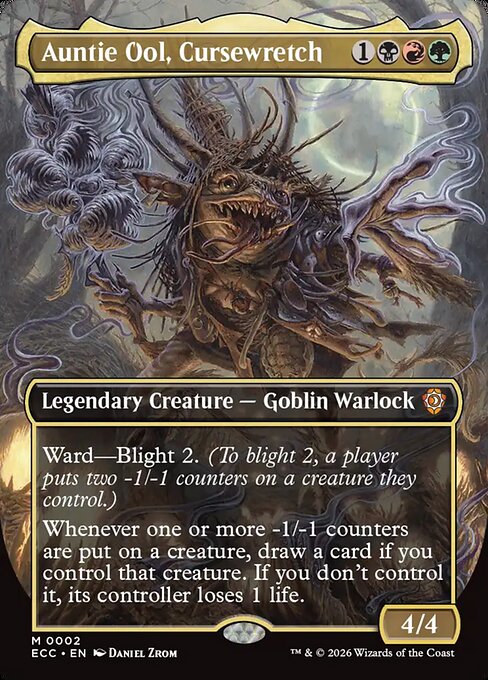
Auntie Ool, Cursewretch pays you a card every time your own creatures take -1/-1 counters — and the box spends its top end on three seven-drops instead of feeding her.
Ool's trigger reads every counter twice. Whenever one or more -1/-1 counters land on a creature, she draws you a card if the creature is yours and bleeds its controller for 1 if it isn't. Your own blight is card advantage; everyone else's creatures are a life total. Resolving the shipped decklist card by card, that one line turns out to be the deck's whole shape: Soul Snuffers enters and puts a counter on every creature in play, which with Ool out means a card for each of yours and a life off each opponent for each of theirs. Black Sun's Zenith for X=1 does the same thing as a three-mana spell that shuffles itself back in for later, and scales up to a real wipe when you need one.
The problem is getting there. The stock list averages 3.67 mana value with 18 cards at five or more, ramps with just six pieces (three rocks, three dorks — typical for the format is 8–12), and eight of its 39 lands always enter tapped. This is a deck that knows exactly what it wants to do and shows up a turn and a half late to do it.
 25
25 20
20 23
23Upgraded list: 100 cards, 37 lands (18 basic), 30 creatures, average mana value 3.23. Mana sources: 25 black, 20 red, 23 green. No Game Changers and no mass land denial, so the deck sets no bracket floor. How brackets work →
What are the best Blight Curse upgrades?
Ranked by how much they change the deck per dollar. Everything here is argued in full below, and the thirteen cuts that make room are further down.
- Nest of Scarabs ($5.34) — every single counter becomes a 1/1 Insect. Soul Snuffers alone makes one for every creature on the battlefield; Skinrender's three counters are three bodies.
- Obelisk Spider ($2.66) — each time you put counters on a creature, every opponent loses 1 and you gain 1. The mass-counter spells stop being symmetrical the moment it's in play.
- Ammit Eternal ($1.17) — a 5/5 for three that takes a counter every time an opponent casts a spell. Under Auntie Ool, that text reads “your opponents' spells draw you cards.”
- Llanowar Wastes, Sulfurous Springs and Karplusan Forest ($2.36 for the trio) — untapped fixing across all three colour pairs, replacing lands that made you wait a turn.
- Fume Spitter ($0.34) — one mana for a counter anywhere, whenever you want it. The cheapest way in the game to switch the whole engine on.
- Yawgmoth, Thran Physician and Crumbling Ashes ($59.91 for the pair) — last on a per-dollar ranking and first on every other one: the two cards every -1/-1 counters deck ends up buying. Both argued in full below.
Board wipes that read “draw cards”
The reason to upgrade this deck rather than replace it: the box already ships the hard-to-reprint core of a -1/-1 counters deck. The Scorpion God draws off every countered death and rebuilds itself from the graveyard. Necroskitter collects every opposing creature that dies wearing a counter. Hapatra, Vizier of Poisons and Blowfly Infestation are the same engine pieces a built-from-scratch list would run.
What the box undersells is how far Ool pushes the symmetrical effects. Midnight Banshee ticks every upkeep: a card for each nonblack creature you control, a life off each opponent for each of theirs, every single turn it survives. Everlasting Torment makes all damage wither, so Chain Reaction stops being a wipe that kills your board too and becomes a full table's worth of Ool triggers — and everything that dies under it dies holding counters, which is exactly the state Necroskitter and The Reaper harvest.
One rules note that changes how you sequence: Ool triggers once per batch, per creature — not per counter. Skinrender's three counters on one target are one card. Soul Snuffers' one counter on each of your five creatures is five cards. Spread beats stack.
Three seven-drops on six ramp pieces
The curve is where the box actually fails. Eighteen cards cost five or more, including all three of the deck's seven-drops — Ferrafor, Young Yew, Grim Poppet and Liliana, Death Wielder — and the ramp behind them is Sol Ring, two more rocks and three dorks. Six pieces where a typical Commander deck runs eight to twelve.
None of the three sevens ends the game when it lands. Ferrafor's Saprolings are indexed to counters already on someone's board, Grim Poppet places its three counters one at a time, and Liliana makes one counter a turn — the thing Fume Spitter does for one mana. The deck's real haymakers, The Scorpion God and Carnifex Demon, cost five and six. So the top gets cut, and the ramp package that comes in is aimed squarely at reaching turn-five plays on turn four.
Draw is the one thing the box has in surplus — fourteen pieces against a typical eight to twelve — which is why nothing in this guide adds a pure draw spell. The deck doesn't need more cards; it needs to cast the ones it has.
Eight taplands, and fifteen spells that want double black
Thirty-nine lands is more than a 3.67 average needs, and eight of them always enter tapped. The three karoo lands are the worst offenders — each one re-taps a land you already paid for. Meanwhile the colour math is lopsided: fifteen stock spells want {B}{B} by turn three and the box hits that about 76% of the time, while red — the deck's lightest colour — only makes a single turn-two pip about 88% of the time.
The fix is three painlands in for four taplands and Path of Ancestry, whose scry only ever fires on a Goblin or Warlock — after these swaps, that's Ignoble Hierarch, Sinister Gnarlbark and Ool herself. One number moves the wrong way in the trade and I want it on the page rather than buried: the karoos each counted as two colours of source, so raw black sources dip from 27 to 25 and the turn-three double-black odds slide from 76.4% to 71.8%. That's the price of never playing a land that skips a turn. It's also why all three ramp adds fetch fixing instead of just basics — Farseek finds a Swamp, Smoldering Marsh or Canyon Slough the turn before the double-black spells come online. Two of the fifteen spells demanding {B}{B} left the deck — though Yawgmoth, Thran Physician arrives asking for it again, so the count only falls by one.
What I'd cut
Thirteen, out of a much longer list you could defend cutting — the five I refused to cut get their own section below.
- Ferrafor, Young Yew — seven mana whose payout depends on counters already sitting on someone's board, with a tap ability that asks it to survive a full turn first. Both halves arrive late.
- Grim Poppet — seven mana for three counters placed one activation at a time, on a body nobody needs to answer.
- Liliana, Death Wielder — seven mana, one counter per turn. The deck cares about the counter, not the loyalty, and one mana buys the counter elsewhere.
- Incremental Blight — five mana, three counters, once. The engines this page adds put out counters every turn for less.
- Eventide's Shadow — a five-mana draw spell in a deck that already draws fourteen ways, and its biggest casts strip the counters off opposing creatures — the exact fuel Necroskitter and Kulrath Knight want left in place.
- Village Pillagers — {R}{R} at five is the hardest cost in the deck (the stock mana pays it on curve about 70% of the time), for one damage on arrival and a Treasure trickle after.
- Flourishing Defenses — the same trigger as Nest of Scarabs, Elves instead of Insects, at five mana instead of two. The deck wants one of these effects, not two copies of the slower one.
- Wickerbough Elder — a four-mana Naturalize you can use exactly once, and only against artifacts and enchantments; spend it and what's left is a 4/4 with no text. The slot goes to removal that fires every turn without asking for mana.
- Rakdos Carnarium, Gruul Turf and Golgari Rot Farm — each one bounces a land you already paid for, in a box with five other lands that enter tapped.
- Savage Lands — enters tapped to fix the same three colours the painlands fix without the wait.
- Path of Ancestry — always tapped, and the scry needs one of two creatures besides the commander.
What I'd add
Thirteen cards, $75.04 all together at Scryfall market prices when this page was written. Eleven of them come to $15.13; the other two are Yawgmoth, Thran Physician and Crumbling Ashes, and they're where most of the money and most of the power lives. Nothing here is speculative tech — it's the package -1/-1 decks have run since Amonkhet, plus the mana to cast it.
Payoffs that count every counter
- Nest of Scarabs ($5.34) — unlike Ool, it pays per counter: Skinrender's three counters are three Insects, and Black Sun's Zenith for X=2 makes two per creature in play. With Hapatra, Vizier of Poisons out, every batch is Snakes and Insects both.
- Obelisk Spider ($2.66) — every batch of counters you place drains each opponent for 1 and gains you 1, and its own combat damage places more. A four-toughness reach body this deck is happy to blight when nothing better is around.
- Ammit Eternal ($1.17) — every spell an opponent casts puts a counter on it, and with Ool out each of those counters is a card. It shrinks from 5/5 as the table plays its turns, then connects once and resets to full size.
Blight on demand
- Fume Spitter ($0.34) — one mana; the sacrifice puts a counter exactly where an engine needs one. Kills a mana dork, finishes a wounded blocker, or turns on Blowfly Infestation mid-combat.
- Banewhip Punisher ($0.28) — removal in two instalments: a counter on arrival (an Ool bleed if you aim it at an opponent), then a sacrifice that kills anything carrying one.
The two the archetype is built around
- Yawgmoth, Thran Physician ($31.42) — pay 1 life and sacrifice a creature: a -1/-1 counter wherever you want it, and a card. Every activation is also an Ool trigger — on your own creature it's a second card, on an opponent's it's a bleed — and he does it as many times a turn as you have bodies and life to spend. The sacrifice half is live here too: a spent Fume Spitter or a Sakura-Tribe Elder that already ramped is exactly what he wants to eat, and {B}{B} plus a discard proliferates the whole board on top. He's the most expensive card in these swaps and the best one.
- Crumbling Ashes ($28.49) — at the beginning of your upkeep, destroy a creature with a -1/-1 counter on it. No mana, no once-per-game, and in this deck something always has a counter — Midnight Banshee alone marks every nonblack creature on the table each upkeep. An earlier version of this page left it out on price and said so in the FAQ; that was backwards, and it's in the list now for the same reason everything else is.
Ramp that fixes the pips
- Farseek ($0.52) — fetches a Swamp, Smoldering Marsh, Canyon Slough or a Mountain. Black is the colour under pressure; this is the two-mana spell that relieves it.
- Nature's Lore ($2.12) — the Forest it finds can be Cinder Glade, and it doesn't come tapped.
- Sakura-Tribe Elder ($0.34) — ramps, then trades with an early attacker for free.
Lands that don't wait a turn
- Llanowar Wastes ($0.68), Sulfurous Springs ($1.18) and Karplusan Forest ($0.50) — all three colour pairs, all untapped. A point of life per coloured tap is cheap in a deck that wins by bleeding, not racing.
One strong card stays out, and not on price. Contagion Engine ($13.41) puts a -1/-1 counter on every creature one opponent controls — an Ool bleed per creature — then proliferates twice a turn from there. The problem is the six on its price tag in mana: this whole page just cut the deck's top end to get it moving, and the Engine sits exactly where the sevens did. If your games reliably go long, it's the first thing to buy beyond these thirteen.
Five cards I argued myself out of cutting
The same lens that flags the seven-drops points at some of the deck's engines, because engines are slow by definition. These stay.
- The Reaper, King No More — six mana with no keywords to its name, but it blights on arrival and steals an opposing casualty every turn. Next to Midnight Banshee's upkeep tick, there's usually a body worth taking.
- Midnight Banshee — {B}{B}{B} is real and so is hitting your own nonblack creatures. With Ool out, that's the point: every upkeep pays you cards for your side and life off theirs.
- Puppeteer Clique — persist means it robs a graveyard twice, and the counter it returns with is one more Ool trigger.
- Aberrant Return — six mana, but the bodies come back wearing counters: raise three creatures and Ool draws three cards on the spot, before their own abilities do anything.
- Grave Titan — the only keeper with no counter text anywhere on it. After cutting the sevens, the six-slot has to justify itself, and ten power across three bodies on one card is the bar.
Where the deck lands after thirteen swaps
Average mana value drops from 3.67 to 3.23. The five-plus count goes from 18 cards to 11, and the two- and three-drop count climbs from 30 to 38 — the deck now curves out through its engine turns instead of past them. Lands go from 39 to 37, which is right for the new average, and the always-tapped count falls from eight to three: Festering Thicket, Canyon Slough and Sheltered Thicket, each of which cycles for {2} when you don't need the land.
Creatures tick up from 28 to 30, and the whole list stays off the Game Changers list, so the Bracket 1 floor the box shipped with survives every swap.
The upgraded decklist
The full 100 after the swaps — hover any name to see the card and its current price.
“Load into the deck builder” opens this list in your account, pinned to the printings the box shipped, ready to edit or save. “Copy decklist” gives you plain text for Moxfield, Archidekt or Arena — no account needed.
Commander 1
- Auntie Ool, Cursewretch

Creatures 29
- Ammit Eternal
- Archfiend of Ifnir
- Banewhip Punisher
- Carnifex Demon
- Channeler Initiate
- Devoted Druid
- Dread Tiller
- Dusk Urchins
- Evolution Sage
- Fume Spitter
- Glissa Sunslayer
- Grave Titan
- Hapatra, Vizier of Poisons
- Ignoble Hierarch
- Kulrath Knight
- Massacre Girl, Known Killer
- Midnight Banshee
- Necroskitter
- Obelisk Spider
- Oft-Nabbed Goat
- Puppeteer Clique
- Sakura-Tribe Elder
- Sinister Gnarlbark
- Skinrender
- Soul Snuffers
- The Reaper, King No More
- The Scorpion God
- Tree of Perdition
- Yawgmoth, Thran Physician







Planeswalkers 1
- Vraska, Betrayal's Sting

Instants 6
- Assassin's Trophy
- Cathartic Pyre
- Fire Covenant
- Infernal Grasp
- Putrefy
- Terminate
Sorceries 12
- Aberrant Return
- Black Sun's Zenith
- Burning Curiosity
- Cathartic Reunion
- Chain Reaction
- Farseek
- Harmonize
- Hoarder's Greed
- Nature's Lore
- Night's Whisper
- Painful Truths
- Persist

Artifacts 6
- Arcane Signet
- Chimil, the Inner Sun
- Commander's Sphere
- Contagion Clasp
- Sol Ring
- Wickersmith's Tools

Enchantments 8
- Binding the Old Gods
- Blowfly Infestation
- Crumbling Ashes
- Everlasting Torment
- Grave Venerations
- Lasting Tarfire
- Nest of Scarabs
- Puca's Covenant
Lands 37
- Canyon Slough
- Cinder Glade
- Command Tower
- Dragonskull Summit
- Evolving Wilds
- Exotic Orchard
- Festering Thicket
- 6× Forest
- Ifnir Deadlands
- Karplusan Forest
- Llanowar Wastes
- 4× Mountain
- Nesting Grounds
- Riveteers Overlook
- Rootbound Crag
- Sheltered Thicket
- Smoldering Marsh
- Sulfurous Springs
- 8× Swamp
- Terramorphic Expanse
- Vernal Fen
- Woodland Cemetery
FAQ
How good is Blight Curse before any upgrades?
The engine cards are genuinely there — The Scorpion God, Necroskitter, Hapatra, Vizier of Poisons and Blowfly Infestation are the exact cards a built-from-scratch -1/-1 counters deck runs. What the box lacks is speed: average mana value 3.67, eight lands that always enter tapped, six ramp pieces. It wins slow games and loses fast ones, so most of these swaps buy tempo — and the two priciest buy the engine pieces the box left out.
Does Auntie Ool draw a card for every -1/-1 counter?
No — once per batch, per creature. Skinrender dropping three counters on one creature is one card; Soul Snuffers putting one counter on each of five creatures you control is five cards. That's also why the deck's mass-counter effects double as its best draw spells.
Doesn't blighting my own creatures just kill them?
Sometimes, and the deck's fine with it: Ool already paid you for the counters, and Dread Tiller and Puca's Covenant put the corpse to work. High-toughness bodies like Channeler Initiate wear counters as stored mana. And Ool herself is awkward to answer — her ward makes an opponent put two -1/-1 counters on their own creature just to target her, which her trigger converts into a life off them, and an opponent with no creatures can't pay the ward at all.
Why cut all three seven-drops?
The box ramps with six pieces, so a seven-drop lands on turn seven or later — and none of the three ends the game when it arrives. Ferrafor, Young Yew needs counters already in play, Grim Poppet works one counter at a time, and Liliana, Death Wielder makes one a turn. The cards that scale with a long game here, The Scorpion God and Carnifex Demon, cost five and six.
Why does this guide recommend a $28 enchantment?
Because Crumbling Ashes is the best removal a -1/-1 counters deck can run: it kills a countered creature on every one of your upkeeps for no mana, and in this deck something always has a counter. It sat at $28.49 when this page was written, and an earlier version of this guide kept it out of the list for exactly that reason. That was the wrong call — swaps here are picked on what they do for the deck, and the price gets quoted honestly instead of doing the picking. It takes Wickerbough Elder's slot.
Is there an infinite combo for this deck?
Not in the box, and none of the thirteen adds makes one. The famous pairing is Devoted Druid plus Quillspike: the Druid's untap cost feeds counters that Quillspike removes for +3/+3, giving unbounded green mana and power. The Druid is already in the deck; Quillspike stays out of this list because a two-card kill changes which bracket the deck can honestly claim.
Do the swaps change the deck's bracket?
No. The box has no Game Changers and neither does anything this page adds, so the floor stays Bracket 1 — in practice the upgraded list plays like a solid Bracket 2 deck. If you take it further, paste the final list into the bracket checker.